
Most people spend far more mental energy trying to save ₹100–₹200 on a shopping trip than they ever spend reviewing the financial decisions that actually move the needle.
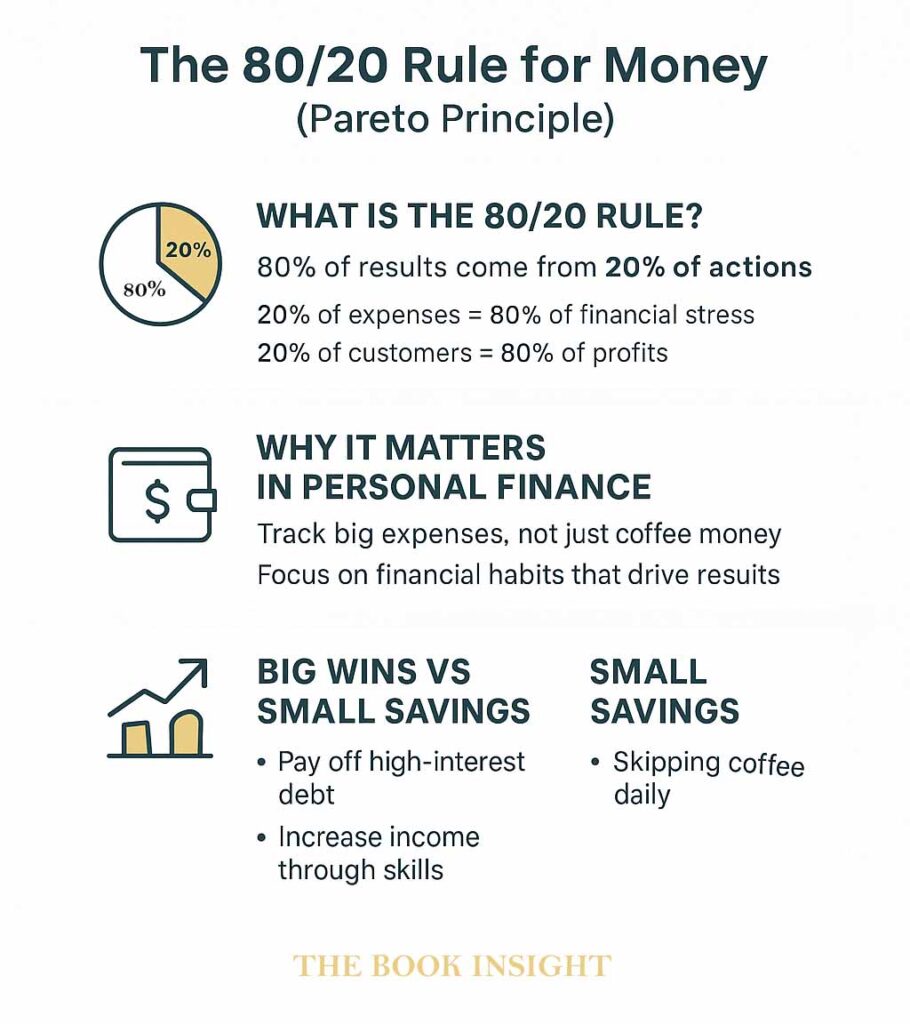
The 80/20 Rule for Money — borrowed from the Pareto Principle — is simple: a relatively small number of financial decisions tend to have an outsized effect on your results, while a much larger number of small decisions add up to comparatively little. In this article, you'll learn what the 80/20 Rule actually means, how it applies to personal finance, which financial decisions tend to matter most, how to find your own financial "20%" in about 15 minutes, and how to build a simple money system around it.
What Is the 80/20 Rule for Money?
The 80/20 Rule for Money applies the Pareto Principle to personal finance. It encourages you to identify the relatively small number of financial decisions that have the greatest effect on your money — things like housing, income, debt, savings rate, and investing — rather than giving equal attention to every small expense.
Note: 80/20 is a principle, not an exact formula. Your own numbers won't split perfectly into 80% and 20% — the value is in the pattern, not the math.
What Is the Pareto Principle?
The 80/20 Rule takes its name from Vilfredo Pareto, an Italian economist who, in the early 1900s, noticed that around 20% of Italy's population owned roughly 80% of the land. That observation — a small share of causes producing a large share of outcomes — turned out to show up in a lot of places well beyond land ownership.
In business, it's common to see a small share of customers generate a large share of revenue — often cited as 20% of loyal, repeat customers driving 80% of a company's sales, while the remaining one-time customers contribute comparatively little. In productivity, a handful of tasks often matter more than the rest of the to-do list combined. Even in health, a small number of habits — smoking, poor diet, inactivity — tend to account for a disproportionate share of long-term problems.
The pattern isn't a law of nature so much as a useful heuristic: outcomes are frequently concentrated in a relatively small number of inputs, and that's worth paying attention to. It doesn't mean every situation splits exactly 80/20 — sometimes it's 70/30, sometimes 90/10 — but the underlying idea holds up remarkably well across very different fields. For our purposes, the interesting question is what this means for money.
How the 80/20 Rule Applies to Your Money
You don't need complicated tools to see this pattern in your own finances — a simple three-month expense sheet is usually enough. Pull together your last three months of expenses, debt payments, subscriptions, housing costs, transportation, lifestyle spending, savings, and investments, and look at them side by side.
The goal isn't to mathematically force your numbers into an exact 80/20 split. It's to answer one question: which few financial decisions are having the biggest effect on where I stand? For most people, that shortlist looks something like housing, vehicle costs, high-interest debt, income, savings rate, and investment behaviour — not the coffee, the snacks, or the occasional impulse purchase.
A three-month review usually reveals that a handful of recurring decisions — not dozens of small daily ones — are shaping most of your financial outcome.
Find Your Financial 20% in 15 Minutes
Here's a simple four-step framework to identify your own financial "20%" — the few decisions worth focusing on first.
The Financial Big Wins That Matter Most
Based on that three-month review, most people's financial "big wins" fall into four broad areas.
1. Increase Your Income
Your income is the foundation everything else is built on. Investing in certifications, online courses, or skill-building that genuinely raises your career value — or exploring a side income — is one of the highest-leverage moves available to most people. This doesn't mean 20% effort literally guarantees 80% more income; it means that prioritizing career growth and better-paying opportunities tends to matter more than most small savings habits combined.
2. Eliminate High-Interest Debt
High-interest debt is one of the biggest obstacles to financial stability, because the interest itself can outweigh whatever you're saving elsewhere. Paying off a card charging 20%+ APR usually does more for your financial position than cutting back on dining out ever could. The debt-avalanche method — paying off your highest-interest debt first while maintaining minimums elsewhere — is a straightforward way to prioritize this.
3. Start Investing Consistently
Spending time understanding the basics — index funds, mutual funds, or other simple long-term vehicles — pays off far longer than almost any other financial habit. Consistency matters more than sophistication here: small, regular contributions to a diversified, low-cost investment plan can support disciplined long-term wealth building, without needing to predict markets or chase trends.
4. Automate Your Financial System
Automatic transfers to savings and investment accounts, automated bill payments, and a simple recurring investment plan all reduce decision fatigue. Once it's set up, this is a one-time decision that keeps compounding in the background — rather than something you have to keep deciding to do every month.
Big Wins vs Small Savings
None of this means small expenses are useless — they matter when they're frequent or add up to a genuinely large share of your budget. The point is prioritization: don't spend all your financial energy on small decisions while ignoring the handful of much larger ones.
| Small Savings | Financial Big Win |
|---|---|
| Skipping one coffee | Reducing an unnecessarily expensive housing cost |
| Using a discount coupon | Negotiating a salary increase |
| Saving ₹100 on shopping | Paying down high-interest debt |
| Searching for small discounts | Automating long-term investments |
A Real-Life Example of the 80/20 Rule for Money
Siya earns around ₹1,80,000 a month — a solid, comfortable income. She lives in an upscale society, rents a spacious apartment, and drives a Mercedes-Benz on EMI. At the same time, she's genuinely trying to "save money" — skipping weekend outings, hunting for discounts, cutting back on small shopping.
The problem is that her three biggest costs — rent, the car EMI, and its upkeep — quietly consume most of her income before she even starts trying to save. Skipping coffee or a weekend outing barely makes a dent next to that. A smarter first move would be to downsize the apartment or reconsider the car — either one would free up far more money than months of cutting small expenses.
This is the 80/20 Rule in practice: focus on the small number of expenses that consume most of your budget, not the other way around.
Common 80/20 Money Mistakes
1. Obsessing Over Tiny Expenses
Over-analyzing every small purchase — coffee, snacks, the occasional impulse buy — feels productive, but it rarely addresses the real drivers of your financial position.
2. Ignoring Income Growth
Many people focus entirely on trimming expenses and never seriously invest in the skills or opportunities that could meaningfully raise their income.
3. Delaying Long-Term Investing
Keeping money liquid "just in case" feels safer, but it also means missing out on years of compounding that are hard to make up for later.
4. Trying to Optimize Everything at Once
Attempting to fix your budget, your debt, your income, and your investments simultaneously usually means none of them get the focused attention they need.
The Psychology Behind Small Financial Wins
Money decisions aren't purely rational — they're tied to how we feel about control and progress. A few patterns explain why small wins feel so appealing:
- Instant gratification: Skipping a coffee or using a coupon gives an immediate, visible sense of achievement.
- Illusion of progress: Frequent small actions feel like improvement, even when they rarely change your actual financial position.
- Comfort zone effect: Big decisions — negotiating salary, investing, changing housing — feel intimidating, so people default to the safer, smaller moves instead.
Negotiating a raise, tackling debt, or starting to invest can feel psychologically harder than skipping a coffee, simply because they involve more uncertainty and a bigger perceived risk of failure. There's also a comparison worth sitting with: skipping a daily coffee might save somewhere around ₹20,000 a year, while starting a retirement investment early enough could realistically grow into several lakhs over the same stretch of time through compounding. Neither habit is wrong, but they're not remotely equal in impact — and shifting your focus toward the bigger decisions, even one at a time, tends to matter more than any number of small daily savings.
A practical way to shift this mindset is to reframe what counts as a "win." Instead of celebrating ₹200 saved on shopping, treat a salary negotiation, a debt payoff milestone, or starting a monthly investment as the real victory worth tracking.
Build Your Personal 80/20 Money System
Does the 80/20 Rule Mean You Should Ignore Small Expenses?
No. If small expenses repeat often enough to become a major budget category on their own, they matter and deserve attention. The 80/20 Rule isn't a license to ignore your daily spending — it's a way of asking a better question: where will my next unit of financial effort create the greatest improvement? Sometimes that's a subscription you've forgotten about; more often, it's your housing, your debt, or your income.
80/20 Rule for Money — Quick Example
Here's a simple, illustrative monthly budget — not a universal recommendation, just an example to show how this works in practice.
| Category | Amount |
|---|---|
| Monthly take-home income | ₹60,000 |
| Housing | ₹18,000 |
| Transportation | ₹8,000 |
| Debt repayment | ₹7,000 |
| Food | ₹8,000 |
| Lifestyle / subscriptions | ₹6,000 |
| Savings / investments | ₹8,000 |
| Other | ₹5,000 |
Instead of trying to optimize every ₹100 within "Other" or "Lifestyle," this person would get more out of examining housing, transportation, and debt first — the three categories most likely to be negotiable or reducible in a way that meaningfully changes the monthly picture.
Frequently Asked Questions
It's the application of the Pareto Principle to personal finance — the idea that a relatively small number of financial decisions, like housing, income, debt, and investing, tend to have a much bigger effect on your financial results than the majority of small daily expenses.
You review your recent spending, debt, income, and savings, then identify which few decisions are driving most of your outcome. Instead of trying to optimize everything at once, you prioritize those top few — usually housing, debt, income, and your savings or investing rate.
Yes — the 80/20 Rule is the popular name for the Pareto Principle, first observed by economist Vilfredo Pareto. In personal finance, it's simply applied to money decisions rather than land ownership or business revenue.
Yes — by directing your attention toward the few decisions (like reducing a major expense or eliminating high-interest debt) that create a larger effect than dozens of small savings habits, it can make your saving efforts more effective without requiring more willpower.
No. Small expenses still matter if they're frequent enough to add up to a significant amount. The rule simply asks you to prioritize — address your biggest financial decisions first, rather than spending all your energy on the smallest ones.
Conclusion: Focus Small, Win Big
Financial progress doesn't require controlling every tiny decision. The 80/20 Rule for Money is a reminder that a small number of choices — your income, your major expenses, your debt, your savings rate, and your investing habits — tend to matter far more than the rest combined.
Build your habits around the decisions that matter most: investing consistently, improving your income, reducing major unnecessary expenses, and paying down expensive debt. Those are the moves that actually shift your financial trajectory.
So instead of stressing over every coffee or small purchase, ask yourself a better question: what are the few money moves that could create the biggest impact on my financial future?
Related Reading
If you want to go deeper on building a wealth mindset around these big-win decisions, these guides go further on the specific skill behind them: