
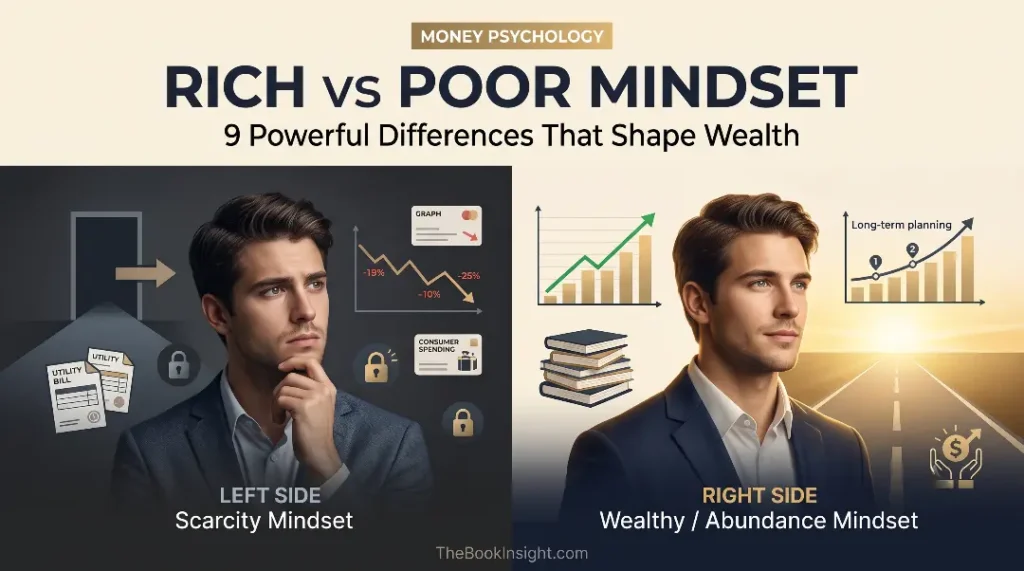
Rich vs Poor Mindset: 9 Powerful Differences That Shape Wealth
Two people can earn exactly the same income and still live completely different financial lives. One may always feel stressed about money, struggle before the end of every month, and constantly worry about the future. The other, with the same income, may feel more financially calm, manage expenses better, invest regularly, and slowly build a more secure life.
So, what creates such different results when both are earning the same amount?
The Difference Starts Before the Money
The answer is not always hidden in how much they earn, but in how they think and behave with what they earn. This is where the difference between a rich vs poor mindset begins.
A rich mindset vs poor mindset is not simply about how much money someone has in the bank. It starts much earlier — with our beliefs, habits, decisions, and the way we respond to money and opportunities. Our beliefs influence our thoughts, our thoughts shape our decisions, our decisions lead to actions, and those actions eventually create our financial results.
Over time, these repeated patterns form what we can call our wealth blueprint. Someone operating from a scarcity mindset may constantly think about what they could lose, while a millionaire mindset looks at how money can be managed, invested, and grown.
That is why earning more money alone doesn't always make someone wealthy. Before financial results change, the thinking behind those results often has to change first.
Rich vs poor mindset is not simply about how much money someone currently has. The difference begins with beliefs, decisions, behaviours, and what someone repeatedly does with money, time, learning, and opportunities.
What Is a Rich vs Poor Mindset?
Before defining a rich vs poor mindset, first we have to understand what a mindset actually is. A mindset is a collection of beliefs, attitudes, and assumptions that shapes how you interpret the world and react to different situations. In simple words, it works like a mental lens that influences your thoughts, behaviour, and decisions.
What Makes the Two Mindsets Different?
A rich mindset is a collection of beliefs and attitudes towards money and wealth that encourages abundance, ownership, growth, and long-term thinking. A person with this mindset generally believes that their financial situation can improve through learning, better decisions, skills, and consistent action.
On the opposite side, a poor mindset believes that very little can change. For example, if someone constantly thinks, "Nothing will change," "wealth is not for people like me," or discourages themselves whenever a wealth-building opportunity appears, their behaviour will naturally follow those beliefs.
This is why money is often the result, while mindset is one of the causes behind it. Two people may start with similar incomes, but their beliefs can lead them towards completely different decisions about spending, saving, investing, learning, and taking opportunities.
Human progress itself reflects this principle. We moved from surviving with limited resources to building modern civilization because people kept questioning limitations, learning, experimenting, and creating.
Wealth often begins in the mind before it appears in the bank account. But thinking is only the beginning — it must eventually turn into action.
Why Mindset Matters More Than Income
A higher income can improve your financial life, but income alone cannot build wealth if the mindset behind handling that money remains the same.
When More Money Doesn't Solve the Problem
One simple example is a person who regularly spends part of their hard-earned income on lottery tickets, hoping to become rich in one shot. Even if income increases, the underlying behaviour may remain unchanged — the person is still depending on luck instead of building wealth systematically.
This is where Carol Dweck's concept of growth and fixed mindsets becomes relevant. A fixed mindset tends to see abilities and situations as difficult to change, while a growth mindset believes improvement can come through learning, effort, and better strategies. The same principle can influence how we approach money.
Why Some People Rebuild After Failure
Self-made millionaires provide another useful example. When they face financial failure, many don't simply wait for luck to return. A millionaire mindset or wealthy mindset focuses on rebuilding through skills, experience, investments, and small consistent actions.
They understand one simple reality: a seed never becomes a tree in a day or a month. Wealth also requires time to grow.
Your Wealth Blueprint Shapes Your Financial Behaviour
T. Harv Eker explains a related idea through the concept of a wealth blueprint — an internal financial "thermostat" shaped by our earlier beliefs and experiences about money.
If your internal beliefs are built around scarcity, your actions may repeatedly reflect those limits. Developing an abundance mindset means consciously questioning those beliefs and creating healthier financial behaviours.
9 Powerful Differences Between a Rich and Poor Mindset
The difference between a rich vs poor mindset is not simply how much money someone has. A person can earn a high income and still live with a scarcity mindset, while someone earning less may already be developing the habits of a wealthy mindset.
The real difference often appears in what people focus on, how they respond to problems, and what they repeatedly do with their money, time, and opportunities.
Rich People Focus on Opportunities, Poor People Focus on Obstacles
Rich-minded people look for opportunities and think about how they can use them to move closer to their goals. A poor mindset often focuses first on everything that could go wrong.
Think about relationships. There may be a thousand reasons to break a relationship, but sometimes one strong reason — love — is enough to keep working on it. The same principle applies here: whatever you continuously focus on starts becoming your reality.
A wealthy mindset doesn't mean ignoring risks. It means seeing the obstacle while still asking, What opportunity is hidden here?
Rich People Take Responsibility, Poor People Blame Circumstances
You may have seen people who constantly blame circumstances, the government, their boss, family, society, timing, or other people for everything happening in their lives.
But when we continuously blame others, we slowly give away control over our own decisions.
People with a millionaire mindset tend to take ownership. If something goes wrong, instead of only asking, Whose fault is this?, they ask, Why did this happen, and what can I do differently next time?
Taking responsibility doesn't mean everything that happens is within our control. It means taking ownership of the part that is within our control.
Rich People Think Long-Term, Poor People Seek Instant Gratification
We have all experienced the attraction of instant gratification: buying something today because it feels good, showing off a lifestyle we cannot comfortably afford, or choosing immediate pleasure over a future benefit.
A rich mindset thinks differently. Instead of asking only, What can I enjoy today?, it also asks, What will this decision give me five or ten years from now?
This long-term thinking may mean delaying an expensive purchase, investing consistently, developing a skill, or building something that produces results later.
Rich People Invest, Poor People Consume
A rich mindset looks at money and time as resources that can be invested. Rich-minded people may invest money into assets and invest their time into learning skills, building businesses, improving knowledge, or creating additional income streams. They understand that what they invest today may provide benefits years later.
A poor mindset is more consumption-oriented. Money comes in and quickly goes toward things that provide temporary satisfaction. Time can work the same way — hours are consumed through entertainment without considering whether some of that time could build something valuable.
The difference is not that wealthy people never consume. They simply understand when to consume and when to invest.
Rich People Learn Continuously, Poor People Think They Know Enough
This is one difference I strongly believe in.
People with a wealthy mindset remain willing to learn — even from their failures. If something doesn't work, their approach is often to understand what went wrong and use that experience for the next attempt.
The opposite happens when someone starts believing, I already know everything. Once we close our minds to learning, growth also begins to slow down. Books, mentors, mistakes, experiences, and even people younger than us can sometimes teach us something valuable.
The more you learn, the more clearly you realise how much there is still left to learn.
Rich People Admire Success, Poor People Resent It
How do you react when someone around you becomes successful? That reaction can reveal a lot about your mindset.
A rich mindset can admire another person's success, learn from it, and sometimes even become part of their journey. Instead of thinking, Why does that person have it?, the question becomes, What can I learn from what they did?
A scarcity mindset, however, may see someone else's success as a threat — as if their achievement somehow reduces our own chances of succeeding. Success is not something we need to resent. It can become evidence of what may be possible.
Related: read our article on The Real Meaning of Success for a deeper perspective on what success actually means beyond money.
Rich People Build Assets, Poor People Accumulate Liabilities
People with a rich mindset generally try to build things that create value over time — investments, businesses, useful skills, intellectual property, or other productive assets.
A poor mindset can easily fall into accumulating liabilities, especially when purchases are made mainly to impress others. Credit cards themselves are not the problem. The problem begins when borrowed money repeatedly finances unnecessary consumption that we cannot comfortably afford.
A useful question before spending is: Will this purchase improve my financial position or continuously take money away from it?
Rich People Embrace Calculated Risks, Poor People Avoid Risk Completely
Building wealth does not mean taking every risk that comes in front of you. A millionaire mindset focuses on calculated risk — understanding the possible downside, studying the opportunity, and then deciding whether the potential reward justifies taking that risk.
A poor mindset may reject opportunities simply because failure is possible.
There is an important difference between gambling and calculated risk. Gambling depends heavily on chance. Calculated risk depends on preparation, knowledge, probability, and accepting that the outcome is never completely guaranteed.
Rich People Think Abundance, Poor People Think Scarcity
Perhaps the deepest difference is abundance mindset vs scarcity mindset.
Scarcity thinking says: There isn't enough. Opportunities are limited. If someone else wins, I lose. An abundance mindset looks at the same world differently: I can learn more, create more value, improve my skills, find another opportunity, and grow beyond where I am today.
This doesn't mean believing that money or opportunities magically appear through positive thinking. An abundance mindset still requires action. The difference is that one mindset constantly searches for limitations, while the other searches for possibilities.
That is ultimately what the rich vs poor mindset comes down to — not the amount currently sitting in your bank account, but the beliefs and behaviours that influence what you do next.
Rich vs Poor Mindset — Quick Comparison
| Area | Rich / Wealthy Mindset | Scarcity / Poor Mindset |
|---|---|---|
| Focus | Opportunities | Obstacles |
| Responsibility | Takes ownership | Blames circumstances |
| Time Horizon | Long-term thinking | Instant gratification |
| Money | Invests | Consumes |
| Learning | Learns continuously | Thinks they know enough |
| Success of Others | Admires and learns | Resents or envies |
| Assets | Builds assets | Accumulates liabilities |
| Risk | Calculated risk | Avoids risk completely |
| Opportunities | Abundance thinking | Scarcity thinking |
Signs You Have a Scarcity Mindset
How do you figure out whether you have a scarcity mindset or not? Sometimes it is difficult because these beliefs have been with us for years and feel completely normal. However, some behaviours can help you identify them.
If you constantly fear losing money and because of that fear never even consider investments such as stocks, SIPs, or other suitable opportunities, it may be a sign of scarcity thinking. Being careful with money is good, but when fear controls every decision, your attention remains completely on what you might lose instead of what you could potentially build.
If someone around you becomes more successful and your first reaction is jealousy, criticism, or talking negatively about them behind their back, notice that reaction. A scarcity mindset can make another person's success feel like your loss. An abundance mindset, on the other hand, asks: What can I learn from this person?
Investment is not only about money. If you continuously avoid investing your time in learning new skills, reading useful books, taking the right courses, or gaining knowledge that could improve your future, scarcity thinking may be limiting your growth.
One of the strongest signs is constantly believing: There isn't enough money, enough opportunity, enough time, or enough success available for me. An abundance mindset doesn't mean ignoring reality. It means believing that through learning, better decisions, and consistent action, more opportunities can be created rather than simply waited for.
How to Develop a Wealthy Mindset
Developing a wealthy mindset does not happen by simply thinking positively about money. It starts when you consciously identify your old beliefs and slowly replace the behaviours that are keeping you in a scarcity mindset.
What Successful Books Teach About Wealth Thinking
After reading multiple books about money and wealth, one thing I have realised is that there is no single formula explained in the same way. Every author looks at wealth from a different angle, but when we connect their lessons, the bigger picture becomes much clearer.
T. Harv Eker teaches that our financial results start with our internal wealth blueprint — the beliefs about money we've stored from childhood and past experiences. His simple formula explains it well: Thoughts → Feelings → Actions → Results. Lesson: before changing financial results, understand the beliefs driving your actions.
MJ DeMarco takes a different approach — moving beyond simply working harder for a salary and focusing on creating value at scale. The more people you can serve and the bigger problem you can solve, the greater the possibility of building wealth. Lesson: don't only exchange your time for money — think about creating and scaling value.
This book brings wealth thinking into everyday life. Stanley and Danko show through the PAW vs UAW concept that high income doesn't automatically create wealth. Many real wealth builders live below their means, control consumption, plan their finances, and invest consistently instead of trying to look rich. Lesson: build financial independence quietly instead of spending money to display success.
This book adds the behavioural side: making money decisions is not only about calculations. How we respond to risk, uncertainty, fear, patience, and our own experiences also shapes financial outcomes. Lesson: knowing about money and behaving wisely with money are two different things.
This book changes the way we look at earning by shifting attention from salary alone towards assets, liabilities, cash flow, and financial education. Lesson: don't spend your entire life only earning money — learn how to make your money work for you.
Together, these books teach one larger lesson: a wealthy mindset is not one belief. It is the combination of better thinking, disciplined behaviour, value creation, financial education, and long-term action.
Final Thoughts
Wealth is not created by income alone. You may earn more than someone else, but if your beliefs and behaviour around money remain the same, a higher income may simply lead to higher spending.
Most financial results begin much earlier — with what we believe about money, opportunities, risk, success, and our own ability to grow. A scarcity mindset keeps our attention on what we may lose or what we don't have, while an abundance mindset encourages us to look for possibilities, learning, and long-term growth.
But changing your mindset doesn't mean that simply thinking about becoming wealthy will make you wealthy. The real process is much more practical:
Developing a wealthy mindset starts with awareness. Identify the beliefs you are carrying, question the ones that are limiting you, and slowly replace them with better financial habits and decisions.
You don't have to change everything in one day. Start with one belief, one decision, and one action at a time.
Because ultimately, your mindset may start the journey — but consistent action is what moves you forward.
Continue Your Wealth Journey
Build Your Mind Before You Build Your Wealth
If this gave you a clearer way to think about money, there's more to explore on wealth, psychology, focus, and self-improvement — practical lessons to keep building on, one idea at a time.