
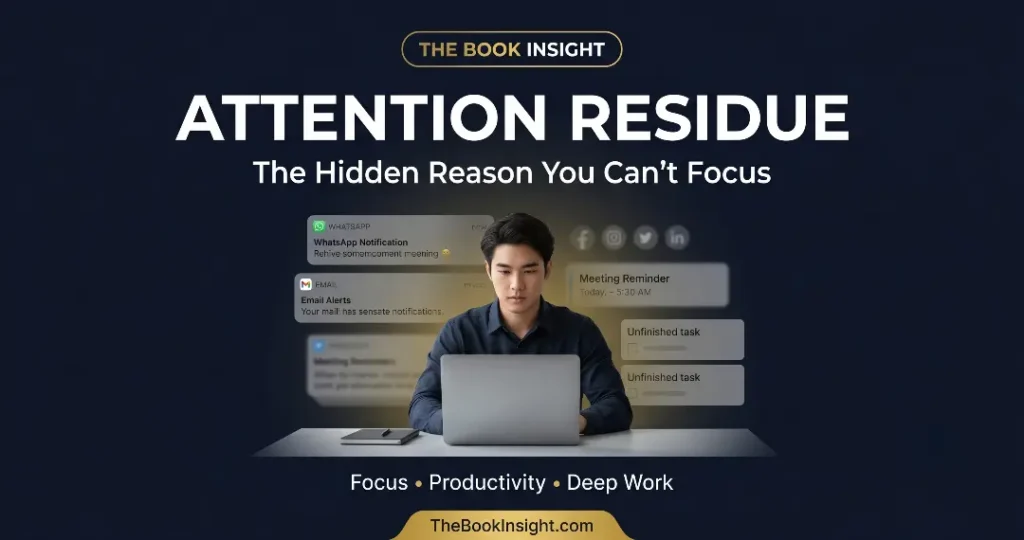
Attention Residue Explained: The Hidden Reason You Can't Focus
You switched tasks. You're physically present. But part of your mind never made the move — and that invisible lag is costing you more than you realise.
I have experienced this many times myself. Whenever I switch from one important task to another, my mind doesn't immediately give 100% attention to the new one. Part of my focus stays behind — stuck on what I was doing earlier — like the previous task is still running quietly in the background.
The truth is, we are not machines that can shut down one task with a single click and instantly move to the next. Our brains need time to disengage before fully focusing on something new. That's why even when we're physically working on a new task, the mind often feels busy, distracted, or pulled in two directions at once.
This is known as Attention Residue — and once you understand it, you'll start seeing it everywhere in your day.
What Is Attention Residue?
The term was coined by researcher Dr. Sophie Leroy in 2009. It describes what happens when a portion of your attention remains attached to a previous task even after you've physically switched to a new one.
When you move from Task A to Task B, your mind doesn't always make a complete transition. Part of your mental energy stays occupied with unfinished thoughts, decisions, or concerns from Task A. As a result, your focus and ability to think deeply on the new task are reduced — sometimes significantly.
For example, if you leave an important work project halfway and immediately start studying, your brain may keep replaying thoughts about that unfinished project. You're physically doing something else, but your attention is divided. That mental carryover is Attention Residue — the hidden mental lag that prevents your brain from giving full attention to what's right in front of you.
Most people stay busy all day but struggle to achieve deep focus — not because they lack discipline, but because Attention Residue is quietly eating away at their mental bandwidth with every task switch.
Attention Residue Theory Explained
How Does the Brain Switch Between Tasks?
Many people believe they can multitask, but the brain doesn't actually work that way. It rapidly switches attention from one task to another — and every switch has a cost.
According to the Attention Residue Theory, every time you move from one activity to the next, your brain must disengage from the previous task and activate a new set of neural pathways. Unlike a computer that can instantly open multiple programmes, the human brain needs time to make that transition.
Why Does Part of Your Attention Stay Behind?
I've experienced this firsthand at work. Imagine you're fully engaged in an important meeting with headphones on, listening carefully — and then someone calls you for an urgent issue that needs immediate attention. Even after shifting to the new conversation, your mind is still connected to the meeting. It takes a few minutes to mentally detach and re-engage.
Think of it like electricity flowing through a wire. Before the current can fully move to Wire A, the connection with Wire B must first be reduced. That lingering mental connection is exactly what the Attention Residue Theory explains. The more frequently you switch tasks, the more Attention Residue accumulates — and the harder deep focus becomes.
Signs You Are Suffering from Attention Residue
Most people experience Attention Residue every day without even realising it. If any of the following sound familiar, your attention may be getting trapped between tasks.
Constant Task Switching
Do you frequently jump between emails, meetings, messages, and work tasks? Every switch leaves part of your attention behind. Instead of making progress, your brain keeps restarting — which increases stress, reduces concentration, and makes even simple tasks feel harder than they actually are.
Checking Notifications Every Few Minutes
One of the biggest causes of Attention Residue today is the habit of constantly checking notifications. Whether you're studying, working on an important project, or even having dinner, every notification pulls your attention away from the present moment. When this happens repeatedly, your focus becomes fragmented — even when you return to the original task.
Difficulty Concentrating
If you find it hard to stay focused on one task for more than a few minutes, Attention Residue may be the reason. Your mind is still processing previous conversations, unfinished work, or earlier distractions — leaving less mental capacity for the task in front of you.
Feeling Mentally Exhausted
Have you ever felt tired even though you haven't done much physical work? Mental exhaustion is a common sign of Attention Residue. Constantly switching attention forces your brain to work harder, draining energy and making it difficult to maintain deep focus throughout the day.
"You may not feel productive. But your brain has been working overtime — just on the wrong things."
Why Attention Residue Destroys Focus
Many people believe that multitasking helps them complete more work in less time. In reality, the opposite often happens. Here's exactly what Attention Residue does to your performance:
Reduced Productivity
When your attention is divided between unfinished tasks, your brain spends more time switching contexts than making meaningful progress. Instead of working efficiently, you keep restarting your focus again and again — exhausting yourself while advancing very little.
More Mistakes
Research has consistently shown that people who frequently multitask are more likely to make errors than those who focus on a single task at a time. When attention is split, details are easier to miss and decision-making becomes weaker.
Tasks Take Longer
Constantly moving between activities often increases the total time needed to complete them. Your brain requires additional effort to reconnect with a task every time you return to it — time that adds up invisibly throughout the day.
Increased Stress and Mental Overload
One unfinished task keeps reminding you it still needs attention, while the new task demands focus at the same time. This mental tug-of-war creates stress, overwhelm, and — over time — a chronic inability to concentrate that many adults mistake for a personal failing rather than a structural problem.
"Lack of concentration in adults is often not caused by a lack of ability — it's caused by too many open mental loops competing for attention at once."
Multitasking creates the problem. Attention Residue is the hidden effect that remains even after you stop multitasking. You can't undo the lag — but you can stop creating it.
Attention Residue Examples in Daily Life
The easiest way to understand Attention Residue is to see how it actually shows up in ordinary routines.
How to Reduce Attention Residue
Understanding the problem is only half the battle. Here are the strategies that have actually helped me improve focus and complete important work more efficiently.
You don't need to work harder to focus better. You need to stop creating the conditions that make focus impossible. Fewer interruptions means less residue, which means clearer thinking — automatically.
What Deep Work and Hyperfocus Teach About Attention Residue
One of the biggest lessons from Cal Newport's Deep Work is that meaningful work requires uninterrupted attention. The more frequently we switch between tasks, the more Attention Residue we carry from one activity to another — quietly degrading the quality of everything we produce.
Newport's practical advice: identify your most important tasks, prioritise them, and give each one your full attention before moving on. When the brain is allowed to focus on a single task without interruptions, concentration improves and work becomes genuinely easier to complete.
A complementary idea comes from Chris Bailey's Hyperfocus. He explains that deep focus should be balanced with intentional periods of rest and open-ended thinking. Just as focused work helps you concentrate, deliberate breaks help your mind recover and prepare for the next session — rather than dragging residue from one work block into the next.
Both Newport and Bailey agree on the same underlying principle: focus is not a character trait — it's a condition you create. Reduce the interruptions, manage the transitions, and the focus follows naturally.
Read our complete summaries: Deep Work Summary and Hyperfocus Summary.
The Books Behind This Article
The ideas in this article are drawn from these books. Full chapter-wise summaries are available on The Book Insight.
Start with Deep Work. It is one of the clearest and most practical books written on the science of focused performance.
Frequently Asked Questions About Attention Residue
Real questions people search about this topic — answered directly.
Attention Residue is a psychological phenomenon where part of your attention remains attached to a previous task even after you've switched to a new one. As a result, your brain cannot fully focus on the current activity, reducing concentration, increasing errors, and making deep work much harder to achieve.
Yes. The concept was introduced by researcher Dr. Sophie Leroy in 2009. Her research showed that when people switch between tasks, a portion of their attention often stays with the previous task — measurably reducing their performance on the next one. It has since been replicated across multiple studies and is widely accepted in cognitive and organisational psychology.
Attention Residue is primarily caused by frequent task switching, unfinished work, constant notifications, emails, meetings, and social media interruptions. The key driver is leaving tasks incomplete before moving on — the brain keeps a mental loop open for anything unresolved, consuming attention even after you've physically moved on.
You can improve concentration by focusing on one task at a time, reducing distractions, turning off notifications, using time-blocking, and scheduling dedicated deep work sessions. The goal is to give your brain enough time to fully engage with a task before transitioning — so it doesn't carry mental residue into the next activity.
Yes — significantly. When students frequently check messages, social media, or switch between multiple subjects, part of their attention remains on the previous activity. This reduces comprehension, weakens memory retention, and lowers overall learning efficiency. Studying for three uninterrupted hours is far more productive than studying for six hours with constant interruptions.
Close the Open Tabs
Many people believe that focus is a natural talent — something you either have or you don't. In reality, focus is a condition you create. And one of the most reliable ways to destroy it, without ever realising you're doing it, is to leave mental tabs open.
Unfinished tasks, constant notifications, unnecessary task switches, unresolved conversations — all of these continue running quietly in the background, consuming attention and mental energy that should be going to the work in front of you.
The biggest lesson from Attention Residue is this: most people don't lose focus because they lack discipline. They lose focus because they've unknowingly created conditions where focus is impossible. The fix isn't about trying harder — it's about eliminating the triggers that create residue in the first place.
Start small. Before switching to a new task, take thirty seconds to write down exactly where you left off on the previous one. That single habit closes the open loop, reduces the mental pull-back, and gives your full attention to what comes next.