
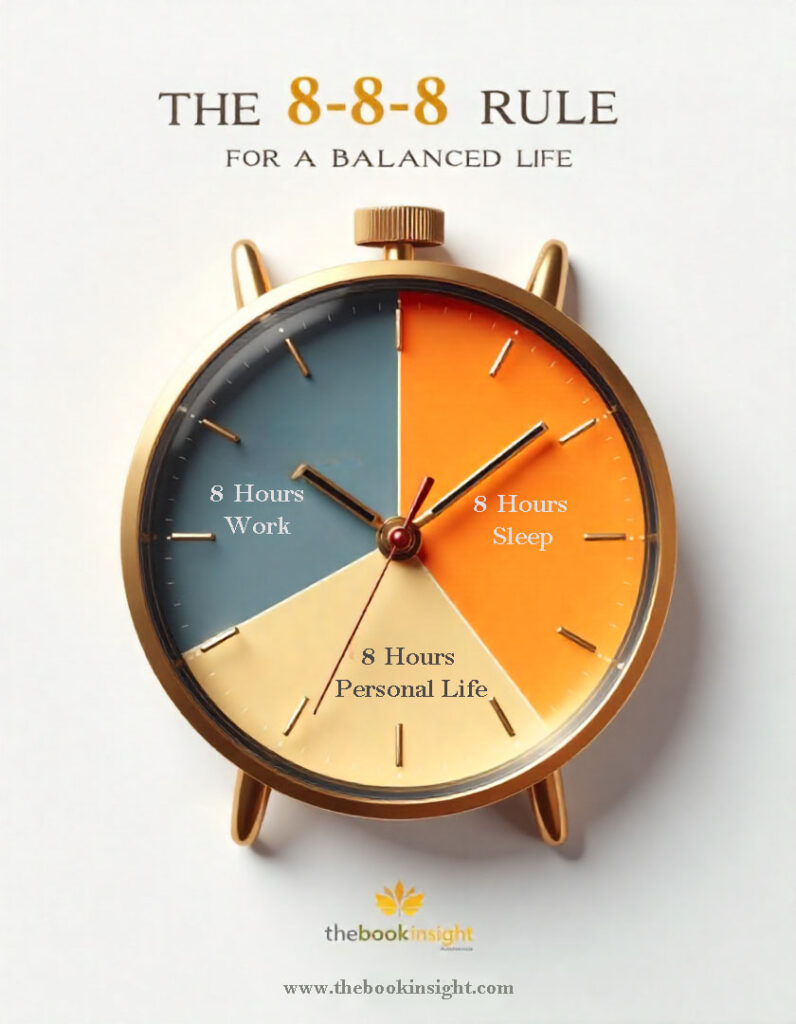
The 8-8-8 Rule: How to Balance Work, Sleep & Personal Life
Have you ever spent a whole day rushing through tasks, only to feel unfulfilled by evening? That's not a productivity problem — it's a structure problem.
That feeling of mental exhaustion, even after a seemingly busy day, is usually a sign of imbalance rather than a lack of effort. This is where the 8-8-8 Rule comes in — a simple time management framework built around three intentional blocks: 8 hours for work, 8 hours for sleep, and 8 hours for personal life.
Most of us live on autopilot, repeating the same routines without questioning whether they add real value. Our mind gets stuck chasing busyness instead of purpose, and that disconnect only surfaces at the end of the day — exhausted, but unsure what the day actually meant.
This article breaks down what the 8-8-8 Rule actually is, where it came from, what a realistic daily schedule looks like, where it falls short, and how to adapt it to a life that rarely fits into three neat blocks.
What Is the 8-8-8 Rule?
Real life rarely splits into exact 8-hour blocks — commuting, meals, and responsibilities blur the lines. The value is in the balance, not the arithmetic.
The 8-8-8 Rule at a Glance
| Time | Purpose | Examples |
|---|---|---|
| 8 Hours | Work | Deep work, meetings, professional responsibilities |
| 8 Hours | Sleep | Rest and recovery, consistent bedtime |
| 8 Hours | Personal Life | Family, exercise, meals, hobbies, reflection |
Where Did the 8-8-8 Rule Come From?
The idea behind the 8-8-8 Rule — sometimes called the Triple Eight Formula — echoes the historical eight-hour-day movement associated with Robert Owen, a 19th-century Welsh textile manufacturer and social reformer. Owen is widely associated with the slogan "Eight hours labour, eight hours recreation, eight hours rest" around 1817, as part of his push against the exploitation of factory workers during the Industrial Revolution. [SOURCE RECOMMENDED]
Society has changed drastically since then, but the underlying idea — dividing the day between labour, recreation, and rest — still holds up in our fast-paced, digitally-driven world. The modern 8-8-8 Rule is best understood as a contemporary echo of that historical principle, not a direct historical document.
8 Hours for Work — Focus, Not Overwork
The first 8 represents time dedicated to your professional responsibilities. Rather than glorifying long hours, this block encourages focused, meaningful effort. Too often, we fill our day with tasks that feel important but don't actually move us forward — the 8-8-8 Rule is a reminder to separate meaningful work from busy work.
A colleague, Jack, was constantly overwhelmed — a long list of tasks and always feeling behind. One day, a simple method helped: prioritize your work by asking "What's important and only I can do?" and "What can be delegated or automated?" Jack sorted his tasks using that lens and realized only 3–4 tasks truly needed his focus. The rest could be handled by others. After sharing this with his manager, he reduced his stress and improved his performance — this is how a work-life balance routine starts: with clarity and boundaries.
As Cal Newport explains in Deep Work, many people find they can only concentrate deeply for a few hours in a day. Rather than filling your entire work block with distractions, one approach is to protect a stretch of focused, distraction-free time for your highest-priority tasks, and use the remaining hours for lighter tasks like communication, admin work, or brainstorming — the kind of Scatterfocus that Chris Bailey describes in Hyperfocus. This isn't a universal rule everyone can replicate exactly — it's an approach worth experimenting with.
Identify 3–4 high-value priorities · Reduce unnecessary task-switching · Delegate where possible · Batch administrative work · Protect a period of focused, uninterrupted time
8 Hours for Sleep — Protect Your Recovery
Sleep is not a luxury — it's a basic biological need. Yet in today's hyper-connected world, many people sacrifice sleep for late-night scrolling or binge-watching, often telling themselves it will help them get more done.
General guidance from sleep researchers suggests most adults do best with somewhere around 7 to 9 hours a night, though individual needs vary. [SOURCE RECOMMENDED] Chronic sleep deprivation has been linked to disrupted hormone regulation, weakened immunity, and difficulty with memory, focus, and decision-making. [SOURCE RECOMMENDED] The "8" in 8-8-8 is best treated as a useful target, not a number everyone must hit exactly — but consistently shortchanging sleep tends to catch up with you.
When you consistently cut sleep short, you build up what's sometimes called sleep debt — and unlike financial debt, it isn't easy to repay quickly. Many people push through the day with caffeine and stress while their body is quietly asking for rest.
Build a Healthier Sleep Routine
- Create a digital curfew — turn off screens 1–2 hours before bed; blue light delays melatonin production and confuses your sleep clock.
- Dim the lights and wind down — soft lighting signals your body it's time to relax; reading, journaling, or light stretching can help.
- Try a weekly digital break — a screen-free evening once a week can help reset your habits, even if it's not easy at first.
Sleep is the reset button for your brain. Without it, even the most productive day won't bring real peace — it deserves its full share of your 24 hours.
8 Hours for Personal Life — The Forgotten Third
This is the most overlooked part of most people's schedules — the time for personal life, self-care, and inner joy. It isn't just "free time"; it's where a large part of your actual life happens. To make it easier to use meaningfully, it helps to think of it in three groups: the 3Fs, 3Hs, and 3Ss — categories to draw from, not nine boxes you need to tick off every single day.
- Family — emotional bonding
- Friends — real connection
- Faith — meaning and belief
- Health — movement, care
- Hygiene — basic self-care
- Hobby — something that brings joy
- Soul — reflection, stillness
- Service — helping others
- Smile — permission to enjoy it
On the 3Fs: emotional bonding reduces stress, and we often look for mentors outside — at work, on social media, in podcasts — when the greatest advisor might be sitting across the room. When was the last time you had a real conversation with a parent or elder family member? Faith or spirituality, whatever form it takes for you, gives meaning to what science alone explains. Books like Ikigai make a similar point about living with intention rather than chasing success on autopilot.
On the 3Hs: your wealth means little if your health fails, and with lifestyle diseases rising even among people who exercise regularly, physical wellness isn't optional. A morning walk clears your mind. A hobby — even one you dropped years ago, like painting or writing — revives something that's easy to lose in adult life. These aren't distractions from real life; they're part of it.
On the 3Ss: making time for self-reflection, even a few minutes of stillness or meditation, tends to make everything else easier to manage. Small acts of service — volunteering, helping someone without expecting anything back — often bring a kind of satisfaction that busyness never does. And "me time" isn't selfish; it's part of staying emotionally steady enough to show up for everything else.
The 3Fs, 3Hs, and 3Ss are reminders to choose from — not a checklist you must fully complete every day. Some days you'll lean on family, other days on rest or reflection.
Example 8-8-8 Daily Schedule
Seeing the framework laid out on a clock can make it easier to picture. Here's one possible working-professional schedule:
| Time | Activity |
|---|---|
| 6:30 AM | Wake up / morning routine |
| 7:00–8:00 | Exercise, breakfast, preparation |
| 8:00–9:00 | Commute / transition into work mode |
| 9:00–5:00 | Work |
| 5:00–6:00 | Commute / decompression |
| 6:00–8:00 | Family time / dinner |
| 8:00–9:00 | Hobby / reading / personal development |
| 9:00–10:00 | Wind down |
| 10:30 PM–6:30 AM | Sleep |
Use this as a template, not a timetable you must copy. Commuting, meals, and daily responsibilities will naturally blur the three categories.
A Compact Student Version
- 7:00 AM — Wake up, get ready
- 8:00 AM–3:00 PM — Classes / study blocks (work equivalent)
- 3:00–6:00 PM — Sports, hobbies, friends (personal time)
- 6:00–9:00 PM — Homework, family, dinner
- 11:00 PM–7:00 AM — Sleep
Does the 8-8-8 Rule Actually Work?
Used as a principle, it works well for most people. It creates awareness of how your time is actually spent, discourages excessive work, protects rest, and reminds you to maintain a personal life. It's simple enough to remember, which is exactly why it's stuck around.
Where it falls short is rigid arithmetic. Commuting, parenting, caregiving, shift work, long workdays, students juggling classes and jobs, and entrepreneurs building something new — none of these fit neatly into three even 8-hour blocks. Someone working a 9-hour day hasn't "failed" the rule; they've simply hit real-world constraints the framework doesn't account for.
The value of the 8-8-8 Rule lies in the principle of balance — not in hitting exactly 8.0 hours in each category every single day.
What If You Can't Follow 8-8-8 Exactly?
Don't abandon the principle just because your schedule isn't perfect. A day that lands at 8.5 / 7.5 / 8, or 9 / 7 / 8, isn't a failure — it's just real life. What matters more is whether one category is consistently stealing time from the others, week after week.
If your exact numbers rarely match, try thinking in terms of a weekly balance rather than a daily one, use flexible time blocks instead of rigid hours, aim for a realistic 7–9 hour sleep range, and protect personal time intentionally even if it moves around your calendar.
Someone working 9 hours most days shouldn't conclude the system has failed them. A more useful question is: "Which part of my life is consistently stealing time from the others?" That's usually where the real adjustment needs to happen.
How to Start Using the 8-8-8 Rule
To make the 8-8-8 Rule effective, start by auditing your current 24 hours honestly before trying to change anything.
- Step 1 — Audit your current 24 hours. Write down roughly how you spend a typical day, without judgment.
- Step 2 — Identify where your time disappears. Look for the gaps between what you intend to do and what actually happens.
- Step 3 — Protect sleep first. It's the block most people sacrifice first, and the one everything else depends on.
- Step 4 — Define work boundaries. Decide when work starts and stops, and what counts as "done for today."
- Step 5 — Intentionally plan personal time. Pick one or two things from the 3Fs, 3Hs, or 3Ss for the week ahead, rather than leaving it to chance.
Simple 8-8-8 Habit Tracker
A basic daily tracker makes the rule easier to stick to in practice:
| Category | Daily Target | What I Planned | Completed? |
|---|---|---|---|
| Work | 8 hrs | e.g., Client project, admin tasks | ✅ / ❌ |
| Sleep | 8 hrs | e.g., Sleep by 11 PM, no screens after 10 | ✅ / ❌ |
| Personal | 8 hrs | e.g., Walk, call a parent, hobby time | ✅ / ❌ |
You can build this in a notebook, a spreadsheet, or a free app like Notion, Habitica, or Google Sheets. Underneath it, ask yourself weekly: What worked? Where did time leak? What should change next week?
Review your tracker weekly and reflect on small improvements. Consistency matters more than perfection.
Common Mistakes When Following the 8-8-8 Rule
- Treating it as rigid mathematics — stressing over 7.5 vs. 8 hours defeats the purpose of a framework meant to reduce stress.
- Calling all office time "productive work" — meetings and scrolling aren't the same as meaningful output.
- Sacrificing sleep first — it's usually the easiest block to cut and the most costly one to lose.
- Turning personal time into screen time — passive scrolling rarely delivers what the 3Fs, 3Hs, or 3Ss actually offer.
- Quitting because one day goes wrong — one imperfect day doesn't undo the value of the framework.
Final Thoughts — Build Balance, Not a Perfect Schedule
The 8-8-8 Rule is more than a time management technique — it's a way of thinking about a balanced, meaningful day. By intentionally dividing your time into work, rest, and self-care, you give yourself room to grow professionally, stay well physically, and stay connected emotionally.
Your version of the 8-8-8 life may look different from anyone else's — and that's fine. Whether you're a student, a working professional, a freelancer, or an entrepreneur, the framework is meant to help you reclaim some control over your time, not box you into someone else's schedule.
"Time is already divided — we just have to live it wisely."
Try the 8-8-8 Rule for one week. Notice what happens to your energy, focus, sleep, relationships, and sense of personal time — then adjust the framework to fit your actual life, not the other way around.
More Guides to Strengthen Your Balance
If any part of this framework struck a chord, these guides go deeper on the specific skill behind them:
Frequently Asked Questions
Real questions people search about the 8-8-8 Rule — answered directly.
The 8-8-8 Rule is a time management framework that divides your day into three parts: 8 hours for work, 8 hours for sleep, and 8 hours for personal life, including family, health, hobbies, and reflection.
As a principle, yes — it builds awareness of how you spend your time and protects rest and personal life. It works less well as an exact formula, since commuting, caregiving, and irregular schedules rarely allow perfect 8-hour splits.
Start by auditing your current 24 hours, protect your sleep first, set clear work boundaries, and intentionally plan personal time using the 3Fs, 3Hs, and 3Ss as categories to choose from — then track it weekly to see what's working.
Yes — classes and study time can stand in for the "work" block, while sports, friends, and hobbies fill personal time. The principle of balancing focused effort, rest, and personal life applies just as well to student schedules.
That's normal — most real schedules don't split evenly. Focus on weekly balance instead of daily precision, and ask which category is consistently losing time to the others, rather than tracking exact hours every day.