
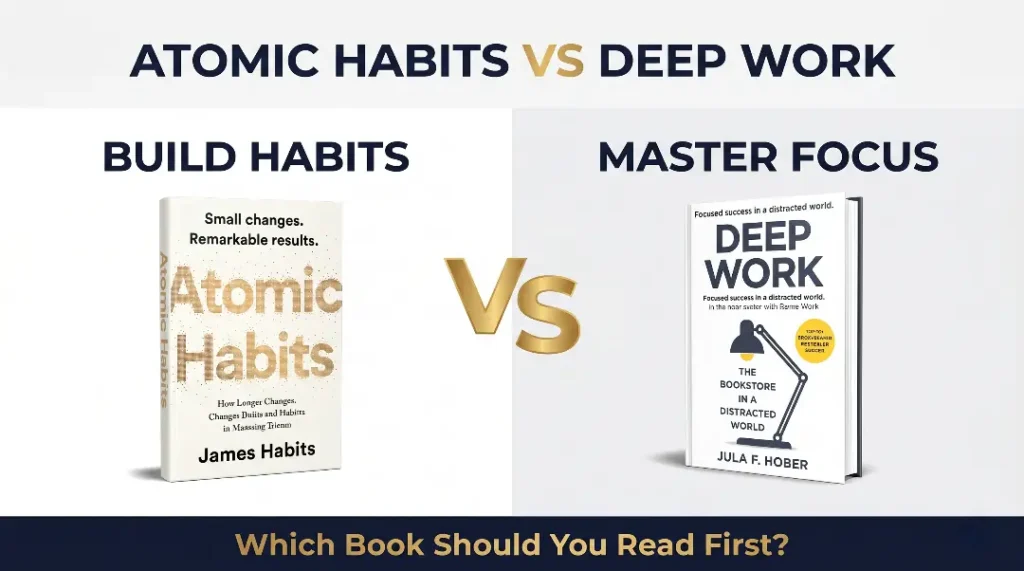
Atomic Habits vs. Deep Work: Which Book Should You Read First?
Two of the most influential productivity books of the last decade — but they solve completely different problems. This guide helps you figure out exactly which one your current season of life actually needs.
Atomic Habits vs. Deep Work at a Glance
| Category | Atomic Habits | Deep Work |
|---|---|---|
| Author | James Clear | Cal Newport |
| Core Idea | Small habits compound into remarkable results | Distraction-free focus is rare and extremely valuable |
| Best For | Building consistency and daily routines | Mastering concentration and eliminating distraction |
| Difficulty Level | Easy — practical, story-driven | Moderate — some sections feel academic |
| Main Strength | Identity-based habit systems | Cognitive depth & digital minimalism framework |
| Pages | ~320 pages | ~304 pages |
| Reading Time | 5–6 hours | 5–6 hours |
| Practicality | Very High | High |
| Focus Area | Behaviour & identity change | Attention & cognitive performance |
| Actionability | Habit stacking, tracking, 2-minute rule | Time-blocking, digital minimalism, deep work rituals |
| Winner Category | Consistency & Routine Building | Focus & Cognitive Performance |
What This Article Will Help You Decide
When we talk about personal transformation and productivity, two of the most powerful books that have reshaped how we think and work are Atomic Habits by James Clear and Deep Work by Cal Newport.
Rather than comparing which book is better, this article explores which book suits your current goals and mindset. Whether you're trying to build better habits or reclaim your focus in a noisy world, this guide will help you decide where to begin.
Atomic Habits — by James Clear
Atomic Habits dives deep into how our daily behaviors — many rooted in childhood — form the building blocks of our lives. The book shows how small, incremental changes in routine can trigger a ripple effect, leading to massive, long-term success. It offers a step-by-step strategy for breaking bad habits, forming good ones, and creating a system that makes change automatic and lasting.
Core Idea
Small habits, when repeated consistently, compound over time to create remarkable results. The book explains how making tiny changes in your daily routine can lead to life-changing transformations.
Main Lessons
- Identity-based habits — real change comes from becoming the type of person who does the habit, not just chasing the outcome.
- The habit loop — cue, craving, response, reward. Understanding this loop is the key to building new habits and breaking old ones.
- Systems over goals — the importance of building systems rather than obsessing over goals, since systems are what actually produce results.
- Breaking bad habits using the same loop structure, by making them invisible, unattractive, difficult, and unsatisfying.
- Extremely practical, story-driven explanations
- Simple frameworks anyone can apply immediately
- Strong focus on identity-level change, not just willpower
- Works for virtually any habit — fitness, reading, finances, focus
- Doesn't address deep cognitive focus directly
- Some concepts repeat across chapters
- Light on the "why" of digital distraction specifically
Deep Work — by Cal Newport
On the flip side, Deep Work addresses the modern crisis of distraction. It reveals how our ability to focus is being hijacked by social media, notifications, and digital overload — costing us both time and mental clarity. Cal Newport explains how cultivating deep, focused work can unlock exceptional results in both our careers and personal lives.
Core Idea
In a world full of distractions, the ability to work deeply — focusing on one task with complete attention — is becoming rare but extremely valuable. This kind of focused work leads to extraordinary results.
Main Lessons
- Cognitive depth — the ability to think deeply about complex problems is a skill that compounds in value as more of the world becomes shallow.
- Time-blocking — structuring your day with dedicated blocks for deep, focused work rather than reacting to whatever comes in.
- Digital minimalism — being deliberate about which digital tools actually serve your goals, and removing the ones that don't.
- The cost of shallow work — Newport illustrates how email culture, constant notifications, and multitasking are killing our productivity and peace of mind.
- Directly addresses the modern attention crisis
- Strong, research-backed case for the value of deep focus
- Practical rituals: time-blocking, distraction-free zones
- Genuinely changes how you view "busy" vs "productive"
- Some sections feel academic or repetitive
- Less applicable if your job requires constant collaboration
- Doesn't address habit-building outside of focus itself
What Type of Mindset Do You Have?
Choosing between Atomic Habits and Deep Work depends on your current mindset and goals. Each book serves a distinct purpose — one helps you build consistency, and the other helps you master focus in a distracted world.
The "Habit Builder" Mindset
If you often find yourself struggling to stick to good habits, or you're stuck in unproductive patterns, Atomic Habits is your blueprint. James Clear breaks down the science of habit formation into simple, actionable steps.
Many young adults start a fitness routine with enthusiasm but lose motivation after a few weeks. Why? Because they rely on motivation instead of systems. Atomic Habits teaches how to create long-lasting behavioral change using tiny improvements that compound over time.
The "Deep Worker" Mindset
If you're battling constant distractions and find it hard to concentrate on what truly matters, Deep Work is the answer. Cal Newport explains how our brains are under attack — from social media, endless emails, and multitasking. Even when you want to focus, you're pulled in different directions.
This book shows how to reclaim your focus and produce high-quality, undistracted work in a noisy world. It's ideal for writers, developers, entrepreneurs, or anyone doing cognitive or creative work.
Atomic Habits vs. Deep Work: Across Every Context
While both books aim to improve your life and productivity, their approaches are fundamentally different. One focuses on tiny changes in routine, while the other is about deep focus and eliminating distractions. Here's how they stack up across the situations that matter most:
Key Differences in Approach
Atomic Habits: Start Small and Build Big
James Clear emphasizes that real change doesn't require grand goals — it begins with small habits practiced daily. If you're trying to:
- Wake up early
- Reduce phone usage
- Start journaling or meditating
- Build a workout routine
Then Atomic Habits gives you a system-based framework that breaks goals into micro-habits. It's not about motivation; it's about designing your environment and routine so good habits stick naturally.
If you want to read more, place a book on your pillow. Small cue = consistent habit.
Deep Work: Cut Distractions to Create Flow
Cal Newport's Deep Work targets the modern-day attention crisis. His approach is clear: remove all distractions to allow your brain to enter a state of deep concentration.
This book is especially effective for:
- Writers and creatives
- Knowledge workers and coders
- Students preparing for high-focus tasks
If you've ever said, "I worked for 8 hours but got nothing meaningful done," this book shows how to reclaim your time.
Use time-blocking and distraction-free zones to create high-output, focused hours — even just 2–3 per day.
Which Book Should You Read First?
This is the question that actually matters. Here's the simplest, most honest way to decide:
Can You Read Both Books Together?
Yes — and the synergy between them is honestly where the real transformation happens. These books were never meant to compete with each other; they were built to solve two halves of the same problem.
Pro Tip: Combine both books — start your day with 30 minutes of Deep Work on your most important habit from Atomic Habits. This compound strategy builds your discipline and progress faster.
My Recommendation: A Personal Journey
If you're wondering which book to start with — Atomic Habits or Deep Work — the answer depends on your current goals and struggles. Let me share my personal journey.
I began with Atomic Habits because I wanted to build a lifelong habit of reading. For me, books have become more than just sources of information — they are true companions that never judge, always teach, and silently guide us toward a better version of ourselves. I used to wish for someone to guide me through life's challenges, but eventually, I realized that I had to be that guide for myself — and books became that path.
Atomic Habits helped me understand the power of tiny changes. I applied its lessons — like habit stacking and identity-based goals — and slowly built new habits that aligned with who I wanted to become.
However, I faced another challenge: distractions. While reading or working, I often found myself pulled away by phone notifications or social media. That's when I picked up Deep Work. It opened my eyes to how the digital world steals our attention and productivity. I applied its strategies — uninstalling distracting apps, turning on Do Not Disturb mode, and focusing on one task at a time — and the results were life-changing.
Start with Atomic Habits if you're building consistency or want to fix daily routines. Move to Deep Work when you're ready to master focus and eliminate distractions.
Bonus Tip — How to Read These Books for Maximum Impact
Reading Atomic Habits or Deep Work isn't just about finishing chapters — it's about transforming your behavior one step at a time. To truly benefit from the ideas in these books, you need to apply them in your daily routine.
Apply Atomic Habits in Your Life
- Start Small: Choose one habit to build (e.g., 5-minute morning walk or 1-page daily reading). Don't overload.
- Use Habit Stacking: Link the new habit with an existing one. Example: "After brushing teeth, I'll write one line in my journal."
- Track Progress: Use a habit tracker or checklist. Seeing progress motivates you to continue.
- Reward Yourself: Celebrate small wins — it trains your brain to love the habit.
- Don't Break the Chain: James Clear emphasizes the power of momentum. If you miss one day, bounce back the next.
Apply Deep Work in Your Life
- Schedule Deep Work Blocks: Reserve at least 60–90 minutes a day for focused work or reading without distractions.
- Turn Off Distractions: Switch your phone to silent, turn off notifications, and close unnecessary tabs.
- Use Time-Blocking: Plan your day with specific time slots for focused tasks. Try apps like Google Calendar or Notion.
- Create a Deep Work Ritual: Set a dedicated workspace, put on calming music, and set a timer. Your brain will associate this with intense focus.
- Start with 1 Thing: Avoid multitasking. Focus on completing one deep task fully rather than switching between many.
Key Takeaways From This Comparison
Explore Both Books in Detail
Want to dive deeper before choosing? Explore both book summaries in detail and let your instinct decide.
Common Questions About Atomic Habits vs. Deep Work
Neither book is objectively "better" — they solve different problems. Atomic Habits is better if your main struggle is consistency — sticking to routines, breaking bad habits, and building new ones. Deep Work is better if your main struggle is distraction — staying focused on demanding tasks in a notification-heavy world. Most readers eventually benefit from both, but which one to read "first" depends entirely on which problem is louder in your life right now.
In most cases, yes. Deep work is itself a habit — and habits require consistent systems to stick. If you read Deep Work first but don't have the habit infrastructure to actually follow through on time-blocking and distraction-free rituals, the strategies tend to fade after a week or two. Building the consistency muscle with Atomic Habits first makes Deep Work's strategies far more sustainable long-term.
Yes, and many readers find this approach works well. One practical method: read a chapter of Atomic Habits in the morning and apply one small habit change, then read Deep Work in the evening and apply one focus strategy the next day. The two systems reinforce each other — habits give you the consistency to show up, and deep work gives you the quality of output once you're there.
Deep Work is specifically built around improving focus. Cal Newport dedicates the entire book to understanding why focus has become rare, the cost of shallow work and constant task-switching, and concrete rituals — time-blocking, digital minimalism, distraction-free zones — for protecting deep concentration. Atomic Habits touches on focus indirectly, mainly through building consistent routines, but it is not a focus-specific book the way Deep Work is.
Both improve productivity, but through different mechanisms. Atomic Habits improves productivity by helping you build the daily systems and routines that compound into long-term output — showing up consistently is itself a productivity multiplier. Deep Work improves productivity by increasing the quality and value of the hours you already work — fewer hours of distracted effort, more hours of high-output, focused work. If you had to choose one productivity lever to pull first, most people get faster, more visible results from Deep Work — but it works best on top of habits that already hold.
If anything, Deep Work is more relevant now than when it was published. AI tools, infinite content feeds, and an even more fragmented attention economy have made sustained, undistracted focus rarer — and therefore more valuable — than ever. The core argument of the book, that the ability to focus deeply is a competitive advantage in a distracted world, has only strengthened with time. The specific tools mentioned (certain apps, for instance) have evolved, but the underlying framework remains fully applicable today.
It's Not About Choosing the Best — It's About Choosing What You Need Right Now
Whether you're battling daily distractions or seeking a transformation through small changes, the right book isn't the "better" one — it's the one that aligns with where you are in life.
Let Atomic Habits guide you when you want to rebuild routines from scratch. Let Deep Work lead you when your mind is cluttered and you crave clarity.
You don't have to choose forever — you just have to choose for now. Read the one that matches today's struggle. The other one will still be there when you're ready for it.