
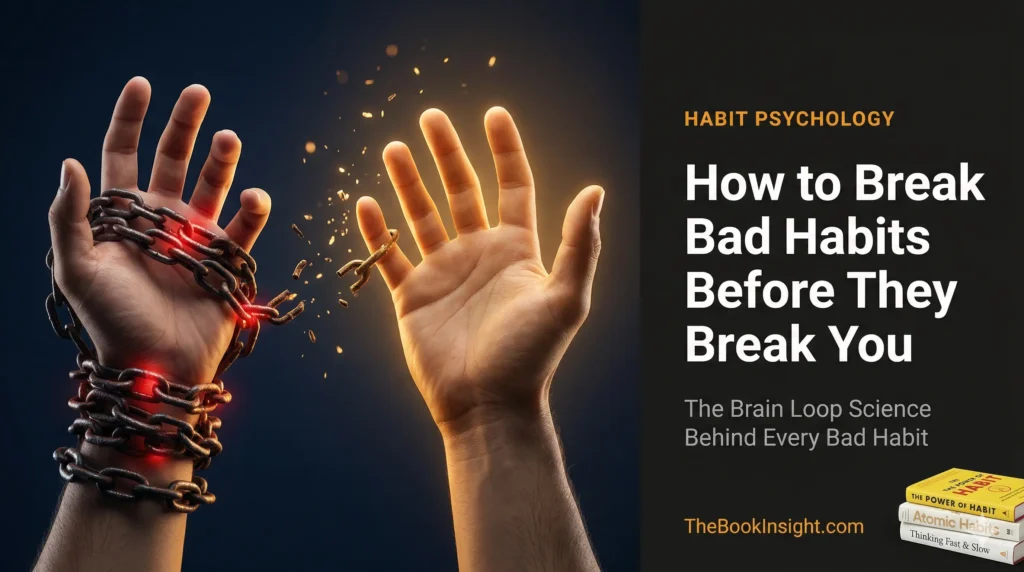
7 Proven Ways to Break Bad Habits (Before They Break You)
It's not a character flaw. It's not weak willpower. The real reason your habits keep winning is neuroscience — and once you understand the loop, you can finally break it.
Here's what nobody tells you about how to break bad habits — it's not a character flaw. It's not weak willpower. It's neuroscience.
When you try to force yourself to break a bad habit with sheer willpower — expecting immediate results on day one — that energy works against you, not for you. Any habit you've carried for months or years isn't just a behavior anymore. It has become a deeply wired part of how your brain operates.
We are, in the most honest sense, slaves to our habits. Everything we do — the way we react, the way we smile, the way we respond under pressure — is attached to habitual patterns running quietly in the background. The moment you try to break them cold, the craving doesn't disappear. It intensifies. Motivation carries most people through 3 to 7 days — and then the loop wins again.
Understanding how to change a habit starts not with discipline, but with understanding the exact mechanism your brain uses to keep you locked in. This article breaks down that mechanism — and gives you 7 proven, practical ways to finally work with your brain instead of against it.
What Is a Bad Habit?
A bad habit is an automatic behavior stored deeply in your daily routine — one you perform without conscious thought. Once formed, your brain's reward system activates it through a subconscious loop, repeatedly triggering the action without any deliberate decision to do so.
Why Your Brain Refuses to Let Go of Bad Habits
Deep inside your brain lives a small but extraordinarily powerful structure called the basal ganglia. Think of it as your brain's habit headquarters — a gatekeeper that decides which actions to allow, which to repeat, and which to suppress. Every habit you have ever built, good or bad, is stored and managed right here.
Here is the critical thing most people miss about habit loop psychology: your habits are not weaknesses. They are your brain's energy-saving mechanism.
How Automaticity Takes Over
While your conscious mind is busy handling work, conversations, and decisions, your subconscious mind quietly takes over in the background — running your habitual behaviors on complete autopilot. This is why you can scroll through social media reels for two hours without a single conscious decision to keep going. The brain handed control over, and the loop ran itself.
This energy-saving system has a name: Automaticity. It is the brain's ability to execute complex, repeated behaviors efficiently without disturbing your conscious attention. Automaticity is not inherently bad — it is what allows you to drive, type, or cook without thinking step by step. The problem begins when harmful behaviors hijack this same system.
Why Awareness Alone Is Never Enough
Your brain is not fixed. Neuroplasticity — the brain's lifelong ability to reorganize itself by forming and strengthening neural connections — means the loop that was built can also be rebuilt. Every habit that was wired in can, with the right approach, be rewired.
But awareness alone is never enough to break bad habits. This is the mistake most people make — they believe that simply knowing a habit is bad will stop it. It will not. Stress and strong emotion actively hijack the brain's decision-making process, shifting it toward automatic, impulsive routines and locking the loop deeper through dopamine release.
This is not a motivation problem. This is biology.
Your habits are not character flaws — they are neurological loops. The basal ganglia runs them automatically to save energy. Understanding this is the first step toward rewiring them permanently.
"This is exactly what Charles Duhigg explored in The Power of Habit — read our full summary to understand how he uncovered the neuroscience behind everyday behavior."
The 3-Part Loop That Controls Every Habit You Have
Every bad habit you have struggled to quit traces back to the same invisible mechanism. Understanding habit loop psychology is the single most practical thing you can learn if you are serious about how to break bad habits permanently.
Psychologists call it the cue-routine-reward loop. Every habit — good or bad — is built and maintained through this exact three-part cycle.
The Cue — The Trigger You Often Cannot See
The cue is the starting signal — a time, location, emotion, person, or preceding action that tells your brain to run the habit automatically. Most people never identify their cue, which is precisely why the loop keeps winning.
The Routine — The Behavior Running on Autopilot
Once the cue fires, the basal ganglia takes over and executes the routine effortlessly. By the time you feel the urge, the brain has already begun. This is why willpower fails at this stage — you are always one step behind.
The Reward — The Dopamine Hit That Locks the Loop
The reward is the dopamine release — the relief, comfort, or pleasure the brain receives at the end. That signal does not just feel good. It instructs the brain to want the loop again. The more it repeats, the deeper the groove becomes.
Here is what most people never realize: your brain has no moral filter. It does not ask whether a habit is good or bad. It only asks one question — did this produce a reward? If yes, the loop gets reinforced. Full stop.
The brain doesn't distinguish between good and bad habits. It only follows the cue-routine-reward loop. Break the loop at any one of these three points — and the habit loses its power.
"James Clear built an entire system around this loop in Atomic Habits — see our summary for his identity-based approach to habit change."
7 Proven Ways to Break Bad Habits (Backed by Brain Science)
Find the Trigger Before You Fight the Habit
Every bad habit has a specific trigger. Take the most common workplace example: after lunch, you go for a walk, and the moment you step outside, the urge to smoke arrives. The walk became the cue that fires the loop automatically — not the real cause.
Your first step is not willpower. It is awareness. Start noticing, journaling, and tracking what happens in the moments before the habit occurs. Charles Duhigg identified five cue categories: time, location, emotional state, people, and preceding action. Your trigger lives inside one of them.
Don't Kill the Reward — Replace the Routine
The core insight of habit loop psychology: your brain is not addicted to the behavior. It is addicted to the reward the behavior delivers. To break bad habits permanently, you do not need to eliminate the reward. You need to swap the routine that delivers it.
Workplace stress creating the urge to smoke? Try a two-minute walk outside. Or ninety seconds of deep conscious breathing. Keep the reward. Change the route to it.
Make the Bad Habit Harder to Do
Every extra step between you and a bad habit reduces the probability it happens. Behavioral scientists call this friction theory — one of the most underused tools in habit change.
Use the stairs instead of the lift. Finish your current task before responding to a colleague's invitation. Delete the app. Move the snacks to the highest shelf. Every physical barrier you create is willpower you no longer have to spend.
Change Your Environment Before You Need Willpower
Willpower is a limited daily resource. By evening, most people have nearly exhausted it. Your environment, however, is permanent until you change it — and right now it is full of silent cue routine reward triggers firing every day without your awareness.
Redesign your space before temptation arrives. Move the object. Change the route home. Rearrange the room. You will not need willpower to resist something that is no longer visible.
Use the "When–Then" Formula
Research on implementation intentions consistently shows that people who pre-decide their response to a cue follow through significantly more often. The formula is simple:
"When [cue happens], I will [new behavior] instead."
By pre-programming your response, you are wiring a new loop before the old one activates. This is habit loop psychology working in your favor rather than against you.
Ask What the Habit Is Really Giving You
Before you can permanently stop bad habits, ask yourself one honest question: what is this habit actually giving me? Most bad habits are emotional coping mechanisms — functional solutions to boredom, anxiety, loneliness, or stress that had no other outlet.
Until that emotion is honestly addressed, the loop will keep restarting. If anxiety is driving the loop, anxiety needs attention — not distraction. That honesty is where real change begins.
Never Miss Twice — The Only Rule That Works
James Clear's most practical rule in Atomic Habits is also his simplest: never miss twice. Missing once is human. Missing twice is where the danger begins — your brain starts registering the absence as the new pattern.
The real secret to how to change a habit is not perfection. It is recovery speed. Set the rule now, before you need it: whatever happens today, I will not miss tomorrow.
You do not need all 7 strategies at once. Pick the one that matches your biggest obstacle right now — cue identification, environment design, or emotional awareness — and apply it consistently for 30 days before adding the next.
The Books That Cracked the Habit Code
Every strategy in this article — the cue routine reward loop, the neuroscience, the seven methods to break bad habits permanently — is rooted in decades of behavioral science research. These three books shaped everything we know about how habits form, persist, and change.
Start with any one of them. You will never see your automatic behaviors the same way again.
Frequently Asked Questions About Breaking Bad Habits
Real questions people search about this topic — answered directly.
The popular "21 days" rule is a myth. Research published in the European Journal of Social Psychology found that habit change takes anywhere from 18 to 254 days depending on the behavior and the person. Stop counting days and start focusing on disrupting the loop — consistency matters far more than speed.
Yes — and willpower is one of the least reliable tools available. Environment design, routine replacement, and the When–Then formula all work independently of willpower entirely. Design your surroundings correctly and you will rarely need to rely on self-control at all.
Because the neural pathway never disappears — it goes dormant. When stress levels rise or the original cue reappears, the old loop reactivates almost instantly. This is why identifying and managing your cues is not a one-time task. It is permanent, ongoing work.
Identify your specific cue. Everything else — replacing the routine, redesigning your environment, using implementation intentions — only works once you know exactly what triggers the loop. Without finding the trigger first, you are fighting completely blind.
More relevant than ever. Charles Duhigg's core framework — that every habit runs on a cue-routine-reward loop — has only been strengthened by neuroscience research published since the book's release. The mechanism he described has not changed, because human brain biology has not changed. Read our full Power of Habit summary →
Your Brain Can Change — But Only If You Work With It
Every time you tried and failed to break bad habits, your brain was not betraying you. It was doing exactly what it was designed to do — protect a loop it had learned to trust. Those failures were not proof of weakness. They were data. And data, unlike character flaws, can be worked with.
Neuroplasticity is real. The loop that was built can be rebuilt. The neural pathway that runs your worst habits today was not always there — and with the right approach, it does not have to stay. The cue can be found. The routine can be replaced. The reward can be redirected.
Breaking bad habits is not about becoming a stronger, more disciplined version of yourself. It is about becoming a smarter one — someone who understands how the brain actually works and uses that knowledge deliberately. You have everything you need to begin.