

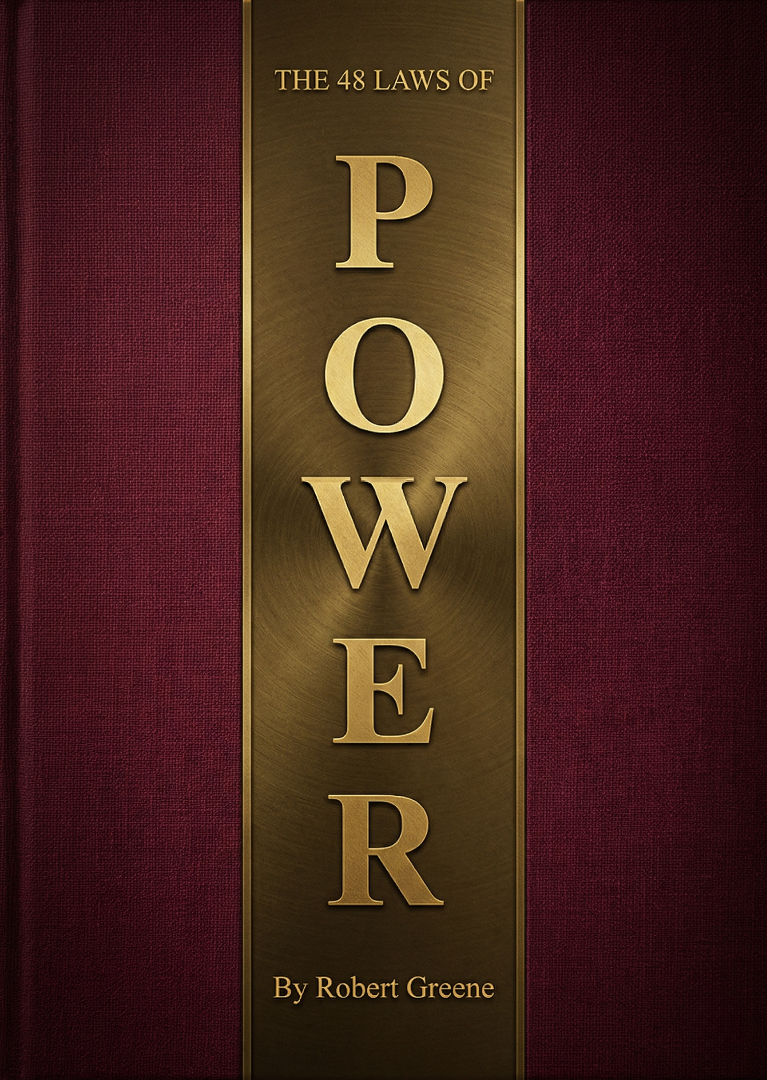
The 48 Laws of Power by Robert Greene - chapter-by-chapter Summary (With Key Lessens)
A complete chapter-by-chapter breakdown of Robert Greene’s timeless power strategies.
All 48 Laws of Power at a Glance
Quick-reference guide — every law, one-line takeaway. Filter by theme or scroll the full list.
| # | Law | One-Line Takeaway |
|---|---|---|
| 01 | Never Outshine the Master Power | Make those above you feel superior — always. |
| 02 | Never Put Too Much Trust in Friends Power | Friends betray; a former enemy has more to prove. |
| 03 | Conceal Your Intentions Power | Keep people guessing — never reveal your next move. |
| 04 | Always Say Less Than Necessary Power | Silence creates power; too many words create vulnerability. |
| 05 | So Much Depends on Reputation Power | Guard your reputation fiercely — it is your most valuable asset. |
| 06 | Court Attention at All Costs Power | Obscurity is the enemy of power — be seen. |
| 07 | Get Others to Do the Work Power | Let others do the labour — take the credit. |
| 08 | Make Others Come to You Power | Whoever moves first loses ground — lure, don't chase. |
| 09 | Win Through Actions, Not Arguments Power | Demonstrate don't debate — actions always speak louder. |
| 10 | Infection: Avoid the Unhappy Deception | Misery is contagious — protect your energy and circle. |
| 11 | Make People Depend on You Deception | Need equals power — make yourself indispensable. |
| 12 | Use Selective Honesty Deception | One honest move disarms suspicion for many calculated ones. |
| 13 | Appeal to Self-Interest Deception | Never appeal to mercy — appeal to what benefits them. |
| 14 | Pose as a Friend, Work as a Spy Deception | Information is power — gather it through friendship. |
| 15 | Crush Your Enemy Totally Deception | Half-victories create future enemies — finish it completely. |
| 16 | Use Absence to Increase Respect Deception | Too much presence breeds contempt — scarcity builds value. |
| 17 | Keep Others in Suspended Terror Deception | Unpredictability keeps people off balance and in check. |
| 18 | Do Not Build Fortresses Deception | Isolation weakens you — stay visible and in circulation. |
| 19 | Know Who You're Dealing With Influence | Never offend the wrong person — read people first. |
| 20 | Do Not Commit to Anyone Influence | Stay independent — let others court and compete for you. |
| 21 | Play a Sucker to Catch a Sucker Influence | Appearing dumber than your target gives you the advantage. |
| 22 | Transform Weakness into Power Influence | Surrender strategically — it disarms aggression and buys time. |
| 23 | Concentrate Your Forces Influence | Intensity beats spread — focus your energy on one source. |
| 24 | Play the Perfect Courtier Influence | Master flattery and subtle influence — never appear to manoeuvre. |
| 25 | Re-Create Yourself Influence | Control your own image — never let others define who you are. |
| 26 | Keep Your Hands Clean Influence | Use scapegoats — always maintain a spotless reputation. |
| 27 | Play on People's Need to Believe Influence | Offer a compelling vision — people follow those who inspire. |
| 28 | Enter Action with Boldness Timing | Timidity is more dangerous than aggression — be decisive. |
| 29 | Plan All the Way to the End Timing | Account for consequences before you begin — never improvise endings. |
| 30 | Make Your Accomplishments Effortless Timing | Conceal hard work — make every success look naturally easy. |
| 31 | Control the Options Timing | Give people choices — ensure every option benefits you. |
| 32 | Play to People's Fantasies Timing | Truth is harsh — fantasy and vision sell far better. |
| 33 | Discover Each Man's Thumbscrew Timing | Find what truly drives people — then use it purposefully. |
| 34 | Be Royal in Your Own Fashion Bold | Act like a king to be treated like one — carry yourself so. |
| 35 | Master the Art of Timing Bold | Strike only when the moment is perfectly right — patience wins. |
| 36 | Disdain Things You Cannot Have Bold | Ignoring what is out of reach gives you power over desire. |
| 37 | Create Compelling Spectacles Bold | What people see moves them far more than what they hear. |
| 38 | Think as You Like, Behave Like Others Bold | Blending in protects radical thinking — conform outwardly, win inwardly. |
| 39 | Stir Up Waters to Catch Fish Bold | Provoke your enemies into anger — they will make your mistakes. |
| 40 | Despise the Free Lunch Bold | Everything free carries a hidden cost — pay your own way. |
| 41 | Avoid Stepping into a Great Man's Shoes Mastery | Create your own identity — never inherit someone else's legacy. |
| 42 | Strike the Shepherd Mastery | Remove the leader and the group scatters — target the source. |
| 43 | Work on the Hearts and Minds Mastery | Win people emotionally before you ever try to win them logically. |
| 44 | Disarm with the Mirror Effect Mastery | Reflect people back to themselves — it is utterly irresistible. |
| 45 | Preach the Need for Change Mastery | Reform gradually — never disrupt everything at once or invite backlash. |
| 46 | Never Appear Too Perfect Mastery | Perfection breeds envy — show a calculated flaw occasionally. |
| 47 | Do Not Go Past the Mark You Aimed For Mastery | Know when to stop — arrogance and greed ruin victories. |
| 48 | Assume Formlessness Mastery | Stay flexible — rigid strategies are the easiest to defeat. |

Laws 1–9: Building & Protecting Your Power Base
These 9 laws are all about how you position yourself in a hierarchy — how you are perceived, how you build a reputation, and how you avoid self-sabotage. They are the foundation Greene builds everything else on.
Law 1 Never Outshine the Master
Always make those above you feel superior. Every boss and superior carries insecurity. The moment you shine too brightly, jealousy ignites — and they quietly replace you with someone less threatening. Let your boss feel like your mentor. Make your wins look like a reflection of their leadership, not a threat to it.
Law 2 Never Trust Friends Too Much
Friends betray you faster than enemies do. They nod in agreement to avoid conflict and hide their real feelings. A former enemy, hired for a key role, works harder to prove themselves and stays more honest with you. They have something to earn — your friend already assumes they have it.
Law 3 Conceal Your Intentions
Never reveal what you are truly working toward. When people cannot see your direction, they cannot block your path. Most people share too much too soon — thinking honesty wins hearts. In reality, it hands your power to others. Talk freely about decoy goals. Announce the achievement, never the plan.
Law 4 Always Say Less Than Necessary
The more you speak, the more ordinary you become. Silence forces others to fill the gap — and in doing so, they reveal far more than you ever will. Talkative people cannot control what they expose. Choose words deliberately, use fewer of them, and let your silence do the work that most people exhaust themselves trying to do with words.
Law 5 Guard Your Reputation at All Costs
Reputation is the foundation that holds all power together. Once it cracks, every opponent attacks from every direction. Start by owning one quality — reliability, sharpness, generosity — and build from there. When someone attacks your reputation, respond slowly and from confidence, never in panic. A fast, defensive reaction tells the world your foundation is weak.
Law 6 Court Attention at All Costs
What is not seen has no value. Never disappear into the crowd. Develop a quality that makes you impossible to ignore — a distinctive style, a bold perspective, an energy that changes the room. Do not fear criticism or controversy. Whether people praise or criticise you, you remain visible. Obscurity is always the bigger defeat.
Law 7 Get Others to Do the Work — Take the Credit
Use the knowledge and effort of others to reach your goals faster. Identify people with skills or creativity you lack and attach your name to their output. The smartest leaders are rarely the most technically skilled — they are skilled at finding talent, deploying it, and owning the results. The name on the building rarely did all the building.
Law 8 Make Others Come to You
Whoever moves first loses the advantage. When others come to you, you control the situation — you are running the show on your own ground. Create desire, build scarcity, and let them chase. Control your emotions, do not get drawn out by impatience, and always receive people on your territory or on neutral ground where they hold no advantage.
Law 9 Win Through Actions, Not Arguments
Arguments produce hollow victories — results produce real ones. Even when you win a debate, the other person walks away more resentful, not more convinced. They were never listening — they were defending. When you prove your point through work instead of words, there is nothing to argue against. Let the outcome speak, and let others agree with what they see.
Power begins in perception, not action. Your reputation, your silence, your visibility, and your relationship with those above you are not soft concerns — they are the actual architecture of your power. Get these foundations right, and every other law becomes easier to apply.
Laws 10–18: The Art of Deception and Strategic Thinking
This is Greene's most controversial cluster — and the most studied. These laws go deep into information warfare, controlling perception, and using human nature against itself. Approach them analytically: Greene is not prescribing evil — he is describing how power actually operates in the real world.
Law 10 Avoid the Unhappy and the Unlucky
Misery is contagious — protect your energy and your circle. Some people are trapped in bad situations through no fault of their own, and helping them causes no harm. But some people attract chaos through their own repeated choices and never change. Spend enough time around them and their negative energy transfers to you. Seek out people who lift your level, not drain it.
Law 11 Make People Depend on You
The more others need you, the more freedom and security you hold. Develop a skill or capability so specific that removing you creates a problem no one else can easily solve. Once people depend on your output, no one dares replace you. And understand this clearly: those who depend on you do not love you — they fear losing you. That fear is your real power.
Law 12 Use Selective Honesty to Disarm
One genuine act of honesty can open the door to a hundred calculated moves. A small, sincere gesture disarms suspicion and lowers defences. People are slaves to first impressions — a single honest moment early on builds trust that lasts far longer than it deserves. As the Chinese principle states: give before you take. Honesty, used deliberately, is not weakness — it is camouflage.
Law 13 Appeal to Self-Interest, Not Gratitude
When asking for help, never remind people what you have done for them — show them what they stand to gain. Powerful people are occupied with their own problems and unmoved by appeals to past favours. Self-interest is the only lever that reliably moves people. Make it immediately clear how helping you serves their goal, and they will act without needing to be convinced.
Law 14 Pose as a Friend, Work as a Spy
In the game of power, information is everything — and friendly behaviour is the fastest way to collect it. People drop their guard around those they trust. Ask indirect questions, listen more than you speak, and share something of your own first — they will almost always reciprocate with what you actually need. A stressed or provoked person reveals even more, though that approach demands precision.
Law 15 Crush Your Enemy Completely
A half-defeated enemy is more dangerous than a full one. From history's greatest generals to today's most competitive industries, the pattern is the same: spare your enemy and they recover, regroup, and return with greater motivation. Leaving someone half-finished allows them to fake friendship while waiting for their moment. Show no personal hostility — but leave them no path back.
Law 16 Use Absence to Increase Respect
The more visible you are, the more ordinary you become. Scarcity creates value — this is as true for people as it is for markets. When you step back, conversation about you increases and your perceived value rises. Learn when to disappear. Distance creates imagination, and people always desire what is not easily available. Too much presence removes the mystery that makes you worth wanting.
Law 17 Keep Others in Suspended Terror
Unpredictability is one of the most underrated weapons in any power game. When your behaviour follows a pattern, others study it, predict it, and plan around it. Break your pattern deliberately. When people cannot find consistency in your actions, they cannot form a strategy against you. Unlike animals, humans can consciously choose to behave in ways that are uncertain — that ability alone separates the powerful from the predictable.
Law 18 Do Not Build Fortresses — Isolation Is Dangerous
Withdrawing from the world feels like protection — it is actually exposure. Isolation cuts off the flow of information you need to survive. It makes you an easy, contained target. Stay connected, stay visible, and keep building relationships. The people around you become your early warning system — they carry intelligence, spot threats before they reach you, and protect your position in ways a fortress never can.
Strategy is not about force — it is about perception and information. These nine laws share one core truth: the person who controls what others know, feel, and believe holds far more power than the person who simply acts. Master deception not to harm — but to protect yourself in a world where most people are already playing this game without telling you.
Laws 19–27: Reading People and Wielding Influence
These laws are about social intelligence — reading the room, managing relationships, and controlling how others perceive you. This group has the highest crossover with self-improvement audiences because every law here applies directly to everyday life: at work, in relationships, and in how you build your identity.
Law 19 Know Who You Are Dealing With
Not everyone reacts the same way — choose your targets and opponents wisely. Some people, when deceived or offended, quietly plan revenge for years. The world contains different types of players, and misreading one can cost you everything. Greene identifies five you must learn to recognise:
The fifth type — the plain, simple-minded person — is not worth the effort of deceiving. Save your energy for opponents who matter.
Law 20 Do Not Commit to Anyone
The moment you fully commit to a side, a group, or a cause, you become their tool. Independence is your most valuable asset — protect it. When you delay choosing, all sides court you and your value rises. The person who stays unaligned holds power over everyone competing for their loyalty. Make others depend on you — never make yourself dependent on others.
Law 21 Play Dumb to Catch the Smart
People never suspect the fool of having a hidden agenda. When you downplay your intelligence, your target lowers their guard, boasts freely, and reveals exactly what you need. Most people cannot resist the chance to appear smarter than someone else — give them that moment and use what they expose. As the Chinese proverb goes: to catch the lion, present yourself as a pig.
Law 22 Use Surrender as a Weapon
When you are weak, fighting for pride is the costliest mistake you can make. Surrender strategically — it buys time, disarms the enemy's aggression, and earns their trust. Real surrender is not defeat; it is a calculated pause. Stay close, appear loyal, and wait patiently while their power slowly declines. When the moment arrives, act with full force. Patience is the hidden weapon in this law.
Law 23 Concentrate Your Forces
Intensity always beats spread — focus on one point and drive through it completely. The world pulls your attention in every direction at once. Most people scatter their energy across too many fronts and master nothing. Napoleon won battles by identifying the single weakest point in the enemy's line and concentrating everything there. One focused effort cuts deeper than ten divided ones ever will.
Law 24 Play the Perfect Courtier
True influence is never visible — it operates through indirection, subtlety, and social mastery. The ideal courtier never self-promotes, never flatters excessively, and never openly criticises those above. They adapt their language to the person they are with, never deliver bad news directly, and make difficult work look effortless. Power exercised too openly creates resistance — power exercised invisibly creates results.
Law 25 Re-Create Yourself
Do not accept the identity that society, family, or circumstance handed you — build your own. The character you were born into is just a starting point. Like a potter shaping clay, consciously reshape who you are. Develop self-awareness first — know how you appear, control your emotions, and decide what image you project. The second step is building a character so distinct that people cannot ignore it.
Law 26 Keep Your Hands Clean
Never let your name be attached to mistakes, dirty work, or controversial decisions. Power players are not destroyed by their errors — they are destroyed by how visibly those errors are connected to them. Use scapegoats, but choose them wisely — innocent targets backfire. Apologising and making excuses only keep the spotlight on you longer. Move attention away quickly, and keep your reputation spotless.
Law 27 Play on People's Need to Believe
People desperately want something to believe in — offer them a vision and they will follow. Facts and logic rarely move people; emotion, excitement, and a sense of belonging do. Build your following with five principles: keep your message vague enough to invite projection, prioritise the visual over the intellectual, structure it like a movement, obscure your income sources, and create a clear "us versus them" identity.
Social intelligence is the most transferable power skill you can develop. These nine laws apply every single day — in offices, relationships, negotiations, and leadership. The thread connecting all of them is simple: understand people deeply before you act, control how you are perceived at all times, and never let anyone else define who you are or which side you are on.
Laws 28–33: Timing, Boldness, and Controlling the Game
Six laws about when and how to act. This group is about the discipline of execution — knowing when to be bold, when to plan ahead, when to stay hidden, and how to control situations by controlling the choices available to others. Timing and positioning are what separate decisive leaders from eternal followers.
Law 28 Enter Action with Boldness
Doubt is more dangerous than the wrong decision — at least a decision creates momentum. Most people are quietly cowardly, dressing their hesitation in excuses and reasonable-sounding concerns. Boldness, on the other hand, puts people at ease and earns admiration. It is not a trait you are born with — Napoleon himself had to build it through repeated practice. Start by holding your value firmly in any negotiation, and others will rise to meet it.
Law 29 Plan All the Way to the End
The end is the only thing that matters — plan every step toward it before you begin. Most people are trapped in the present moment, reacting to immediate pressures without ever looking ahead. As Cardinal de Retz observed: people fear nearby dangers far more than distant ones — yet it is the distant ones that destroy them. When you think clearly about future outcomes in advance, you move with calm confidence while others scramble.
Law 30 Make Your Achievements Look Effortless
Never reveal the effort, struggle, or planning behind your results — let the outcome speak alone. Power is partly a performance, and the most admired performances look natural. When you expose your methods, you invite others to copy, critique, and eventually replace you. The more mysterious your process appears, the more people revere what you produce. Conceal the hard work — show only the effortless result.
Law 31 Control the Options
True control means making others choose between options you have already designed in your favour. When people believe they are deciding freely, they lower their resistance — yet every path you offer leads to your preferred outcome. This is the subtlest form of manipulation: the victim feels empowered while you hold all the cards. Give people the feeling of choice, and quietly remove every option that does not serve you.
Law 32 Play to People's Fantasies
People do not want the truth — they want relief from it. Reality is slow, difficult, and unglamorous. Fantasy promises sudden transformation, no sacrifice, and a completely new world. The person who offers a compelling fantasy will always draw a larger following than the one offering honest, hard facts. Do not shatter illusions unless you are prepared for the resentment that follows. Learn to speak to what people wish were true.
Law 33 Discover Each Person's Weak Spot
Every person has a psychological pressure point — find it, and you hold the key to influencing them. Weaknesses hide behind the things people overcompensate for: the loudest person in the room is often the most insecure. As Freud observed, if the lips stay silent, the fingers speak — every small detail reveals what people consciously try to hide. Develop your listening and observation skills. The real intelligence is always in the tiny, unguarded moments.
Execution without timing is wasted effort — timing without boldness is a missed opportunity. These six laws share one underlying demand: you must think further ahead than everyone else in the room, act decisively when the moment arrives, and control the structure of the game before anyone else realises the game has started. Plan to the end, move with boldness, and let others choose between the options you designed.
Laws 34–40: Audacity, Spectacle, and Playing the Long Game
Seven laws focused on how you carry yourself, how you create impressions, and how you think and act over the long term. This group connects strongly with personal branding, self-image, and the ability to stay emotionally in control while others react impulsively. How you present yourself determines how the world receives you.
Law 34 Act Like a King to Be Treated Like One
How you present yourself tells the world exactly how to treat you. A humble, apologetic image invites disrespect. An emperor respects themselves first — and that self-respect becomes the signal others follow. This is not about arrogance; it is about dignity in every situation. Believe you will do great things, carry yourself accordingly, and people around you will unconsciously rise to match the standard you set.
Law 35 Master the Art of Timing
Patience is not weakness — it is the discipline to wait until the moment is right. Greene identifies three types of time: long-term time, which requires patience and direction; short-term time, where you disrupt your opponent's rhythm and force their mistakes; and conclusion time, where you move fast and finish completely. Rushing creates problems that patience would have avoided. The powerful person controls the clock — they do not chase it.
Law 36 Disdain What You Cannot Have
The more desperate attention you give something, the more power you hand it over you. When you cannot obtain something — an enemy's approval, a missed opportunity, a lost deal — obsessing over it reveals weakness. Ignore it completely, as though it never existed. Disdain is a king's prerogative. Do not turn a small enemy into a large one by feeding them your energy. Indifference is often the most powerful response available.
Law 37 Create Compelling Spectacles
Words can be misunderstood — powerful symbols and images speak directly to the emotions. People connect to what they see far more deeply than what they hear. Build an aura around yourself through visual presence, distinctive symbols, and memorable impressions. In an age of social media and content, this law is more relevant than ever: what people see and feel about you shapes your power far more than any argument you make.
Law 38 Think as You Like — Behave Like Others
Blending in publicly while thinking freely privately is how radical ideas survive long enough to matter. When you openly challenge shared beliefs, people feel threatened and punish you — not because you are wrong, but because difference makes them uncomfortable. Share unconventional thinking only with those who can genuinely receive it. Outwardly conform, inwardly stay free. This is the strategy of every effective disruptor throughout history.
Law 39 Stir Up Waters to Catch Fish
Anger destroys strategy — keep yours controlled while provoking theirs. An angry opponent makes mistakes, overreacts, and exposes their weaknesses. Your calm in the face of their fury is itself a form of dominance. Greene goes deeper: most anger is not really about the present situation — it is old wounds reopened. When you understand this, you stop taking provocations personally and start using them deliberately. Emotional control is a power multiplier.
Law 40 Despise the Free Lunch
Nothing is truly free — everything given without a price carries a hidden cost. Freebies create obligation, guilt, and dependency — all of which quietly transfer power away from you. When you pay the full price for something, you stay free of those invisible debts. Spend generously and deliberately, because money and resources spent with intention build power. The greedy person who chases every freebie ends up owned by them.
How you carry yourself is the first and most visible form of power you possess. These seven laws all point to the same truth: self-image, emotional control, and the impressions you create are not soft concerns — they are strategic assets. Act with the dignity of someone who has already won. Stay calm when others lose control. Never chase what you cannot have. These habits alone will separate you from most people in any room.
Laws 41–48: Mastery, Adaptability, and the Final Game
The final eight laws are Greene's most philosophical. They are about identity, adaptability, knowing when to stop — and ultimately, the mindset of someone who has truly mastered power. Law 48 is the most quoted of all 48 laws, and the natural closing thought of the entire book.
Law 41 Avoid Stepping into a Great Man's Shoes
If you follow a legend, you will always be judged against them — and always fall short. People remember the original. Whatever you do in the same mould will look like a copy. Forge a completely different path, build a different identity, and create your own benchmarks. As history shows repeatedly: those who tried to replicate the methods of great predecessors failed, while those who broke the mould entirely built new empires.
Law 42 Strike the Shepherd
Every problem has a source — eliminate the source and the problem dissolves. Trouble rarely comes from the crowd; it comes from one ambitious, disruptive individual who poisons the group's goodwill. Remove that person — quietly, swiftly, completely — and the followers scatter without their leader. Power in any era, no matter how democratic it appears, still concentrates in the hands of a few. Find and neutralise the real player, not the crowd.
Law 43 Work on Hearts and Minds
Force creates resistance — genuine conviction creates loyalty. The people around you will only work for you willingly when they believe it serves their own interest. Appeal to emotions first, then to logic. Show people how following your direction benefits them directly. Those who feel emotionally invested become loyal; those who feel used become your enemies. The fastest path to someone's cooperation is through what they already want.
Law 44 Disarm with the Mirror Effect
Mirroring your opponent — copying their actions and strategies exactly — is one of the most disorienting weapons available. It removes their ability to predict you, irritates them deeply, and forces an overreaction that exposes their weaknesses. The mirror also works psychologically: reflect people's values and desires back at them, and they feel an almost irresistible connection to you. What we see in a mirror, we instinctively trust.
Law 45 Preach Change — But Reform Slowly
People say they want change, but their habits and identities are deeply tied to the existing order. Move too fast and you trigger rebellion. The smarter approach: appear to honour tradition while making small, incremental shifts underneath. Let people adapt gradually before they realise how much has changed. Frame every reform as a continuation of the past, not a break from it — and you will move further, faster, with far less resistance.
Law 46 Never Appear Too Perfect
Perfection breeds envy — and envy quietly creates enemies who never announce themselves. When you appear entirely flawless, others feel diminished by comparison and begin working against you in small, hidden ways. Deliberately reveal a harmless flaw or an occasional incompleteness. It makes you human, lowers the threat you pose, and defuses the resentment before it builds. The powerful person controls even how their imperfections are perceived.
Law 47 Do Not Go Past the Mark You Aimed For
Victory has its own momentum — and if you do not stop it deliberately, it will carry you past where you should have stopped. Overconfidence after a win is one of the most common causes of destruction in power. The more enemies you defeat, the more new ones you create by continuing. Set a clear goal, reach it, then stop. The discipline to halt at the right moment is rarer — and more powerful — than the ability to win.
Law 48 Assume Formlessness
A fixed strategy is a visible target — become like water, and no enemy can hold you. The moment you commit to a rigid form, opponents study it, predict it, and build a counter. True power stays fluid — adapting to every environment, shifting shape as conditions change. Formlessness is not disorganisation; it is the highest form of strategic flexibility. Never take anything personally, never appear defensive, and never stop evolving.
Power is not about force — it is about awareness, adaptability, and self-mastery. These final eight laws point to one unified idea: the person who truly understands power does not cling to any fixed identity, strategy, or victory. They move like water — formless, patient, and impossible to contain. Know when to act, know when to stop, and above all, know yourself well enough to never let success or failure define your next move.
Final Verdict — Is The 48 Laws of Power Worth Reading?
Our honest take after a complete read-through of all 48 laws.
- ▸ You want to understand how power actually operates in the real world — not how it should work in theory.
- ▸ You are building a career, a business, or a personal brand and want to think more strategically.
- ▸ You have felt powerless in situations and want to understand why — and what to do differently.
- ▸ You are a student of human nature, history, psychology, or leadership.
- ▸ You are looking for a feel-good, morally reassuring read — this book is deliberately amoral.
- ▸ You want step-by-step how-to instructions — Greene teaches through historical stories, not checklists.
- ▸ You are easily unsettled by ruthless thinking — some laws will make you uncomfortable, intentionally.
The 48 Laws of Power is not a manual for becoming evil — it is a mirror held up to the way power has always worked throughout history. Whether you choose to use these laws or not, understanding them is non-negotiable — because the people around you already are. This book will change how you read every room, every relationship, and every situation you walk into. That alone makes it essential.
Want to go deeper on any specific law?
Jump back to the quick-reference table ↑
Frequently Asked Questions
Answers to the most searched questions about The 48 Laws of Power.
The main message of The 48 Laws of Power is that power operates by specific, observable rules — and those who understand these rules can protect themselves and gain influence. Robert Greene argues that power is neither good nor evil; it is simply a force that exists in every human relationship. Understanding it is essential whether you choose to use it or not.
Yes, The 48 Laws of Power is widely considered one of the most important books on strategy and human behaviour. It has sold over 1.2 million copies and is read by entrepreneurs, executives, and leaders worldwide. It is not a feel-good book — it is deliberately analytical and amoral — but for anyone who wants to understand how power truly operates, it is essential reading.
Many readers consider Law 1 (Never Outshine the Master) the most important because it governs every professional relationship you will ever have. Law 48 (Assume Formlessness) is considered the most philosophical and is often cited as Greene's ultimate conclusion. Law 15 (Crush Your Enemy Totally) is the most controversial and most searched.
Yes. The 48 Laws of Power has been banned in several US prisons, including in Wisconsin and other states, because prison authorities believe it could be used to manipulate staff and other inmates. Ironically, this ban significantly increased the book's popularity and cultural status outside prison walls.
The full book is approximately 480 pages and takes most readers between 10 to 15 hours to read completely. This summary covers all 48 laws in approximately 12 minutes, grouped by theme with key takeaways for each law.
The 48 Laws of Power is most valuable for entrepreneurs, professionals, leaders, and students of history and human psychology. It is particularly useful for anyone who has felt powerless in a professional or social situation and wants to understand why. It is not recommended for readers seeking moral guidance or step-by-step instructions — Greene teaches through historical observation, not checklists.
You Might Also Enjoy