
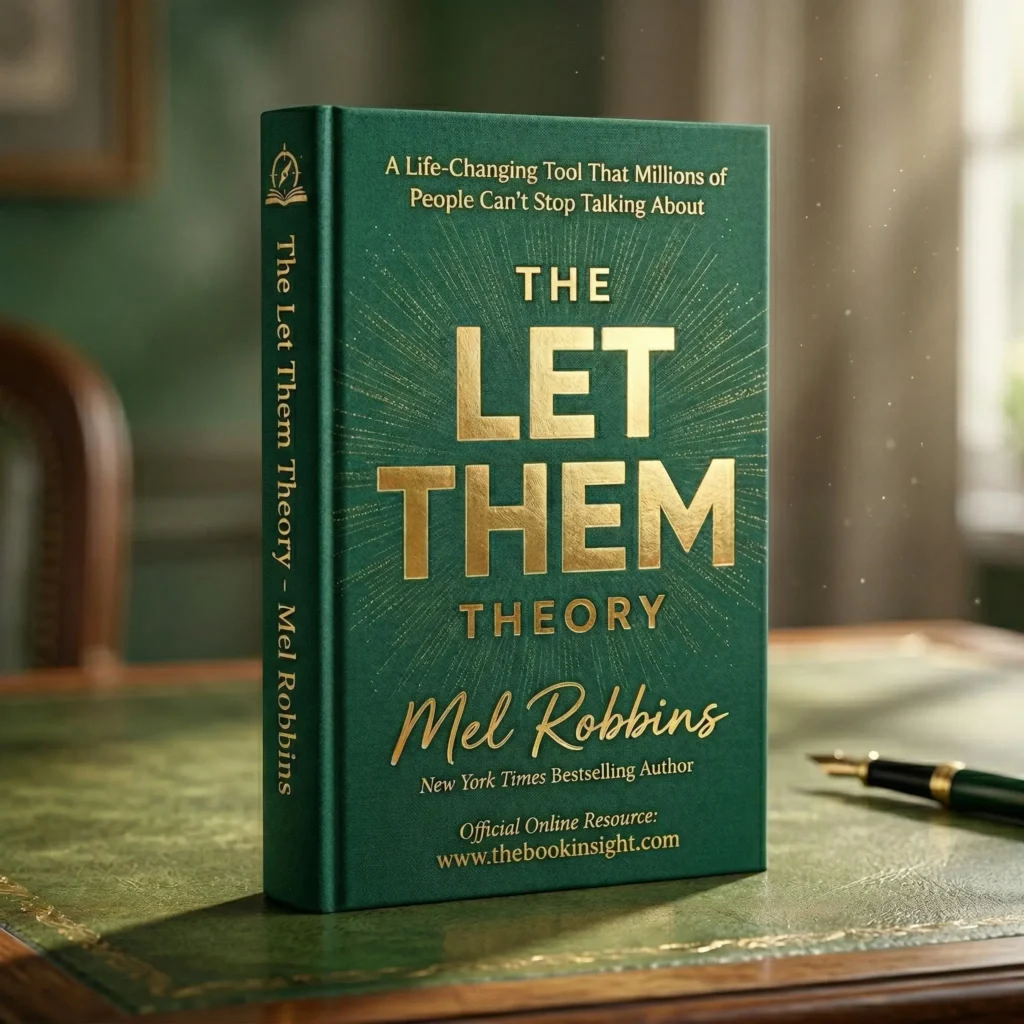
Book Name: The Let Them Theory
Author Name: Mel Robbins
The Let Them Theory Summary
In The Let Them Theory, Mel Robbins reveals one radical idea: stop controlling others – just let them be. This book teaches you to reclaim your energy, peace, and power by detaching from people’s choices. We’ve broken it down chapter-wise with key takeaways so you get the full value in minutes.
Chapter 1: Stop Wasting Energy on What You Can’t Control
What Is the Let Them Theory?
Just two words – Let Them – and everything shifts.
The Let Them Theory by Mel Robbins is simple: stop trying to control what others think, say, or do. Because the moment you release that grip, you get something powerful back – your own energy, focus, and peace.
Most of us spend hours replaying other people’s reactions. Did they like it? Why did they say that? What do they think of me? That mental loop is exhausting – and it’s stealing time from your own life.
Mel Robbins’ Personal Story
Mel didn’t discover this in a therapy session. She lived it.
She shares how these two small words saved her from constant overthinking and people-pleasing. Once she stopped reacting to everyone around her, she finally had the headspace to focus on what actually mattered – herself and her goals.
This is what The Let Them Theory book summary is really about: not indifference, but freedom.
Whatever others choose to do – let them. Your life is waiting.
Let Them Theory Key Takeaways
- “Let Them” means releasing control over others’ actions and opinions
- Trying to manage others drains your energy and steals your focus
- Most mental stress comes from reacting to things outside your control
- Mel Robbins used this mindset personally to stop overthinking
- Letting go isn’t weakness – it’s how you reclaim your own power
- Your time and energy belong to your life, not other people’s choices
Chapter 2: Let Them. Then Let Me.
Mel’s Story: The Uninvited Moment
Mel Robbins found out her friends had a get-together – and she wasn’t invited.
Within minutes of seeing photos on social media, the overthinking began. Why didn’t they call me? What did I do wrong? Sound familiar? It happens to all of us – even as adults. That spiral of questions drains you completely.
This is exactly where The Let Them Theory by Mel Robbins begins in real life – not in theory, but in a painful, everyday moment.
Putting the Theory Into Practice
Mel repeated it over and over – let them. Let them make their plans. Let them leave. Let them choose.
And slowly, the weight lifted.
Because here’s the truth – controlling others is just an illusion of safety. We control because we’re afraid of rejection, disappointment, and pain. But that control never actually protects us. It just keeps us stuck.
What Comes After “Let Them”?
This is the part most people miss in The Let Them Theory book summary.
“Let Them” gives you relief – but “Let Me” gives you direction.
Once you stop focusing on others, you turn inward. Let me decide my attitude. Let me own my choices. Let me grow.
The theory is only complete when both halves work together – Let Them free others, Let Me reclaims you.
Let Them Theory Key Takeaways
- “Let Them” starts with releasing people who didn’t choose you
- Controlling others is an illusion – it never removes real pain
- Social comparison and overthinking steal your peace instantly
- “Let Them” alone brings relief, but it’s temporary
- “Let Me” is the second step – it returns ownership back to you
- True power means controlling your attitude, values, and response – nothing else.
Chapter 3: Stress Is Normal. Your Reaction Isn’t.
The Coffee Shop Moment
Mel Robbins was stuck in traffic. Then a slow coffee queue with only two staff made it worse.
The frustration was building – until she said it quietly: let them. Let them work at their pace. I can’t control this.
And just like that – one second – the tension dropped.
This is the everyday magic of The Let Them Theory by Mel Robbins. Small moments, practiced daily, create a calmer life.
Mind in Tension
Mel shares insights from Dr. Aditi Nerurkar about how our brain actually works under stress.
Two parts matter here. The prefrontal cortex – handles thinking, decisions, and control. And the amygdala – a tiny almond-shaped part that triggers fight, flight, or freeze the moment you feel threatened.
Dr. Aditi says 7 out of 10 people live in constant tension. When stress stays too long, the amygdala takes over – and you’re stuck in survival mode.
How to Reset?
This is a key insight from The Let Them Theory book summary – stress isn’t permanent. It’s a biological switch.
When you say let them, you’re literally sending a calm signal to your amygdala. Then say let me breathe. Slow down. Reset. Come back to yourself.
That’s not weakness. That’s intelligence.
Let Them Theory Key Takeaways
- Everyday frustrations – traffic, queues, people – are chances to practice “let them”
- The amygdala hijacks your thinking when stress goes unchecked
- 7 in 10 people are stuck in constant tension mode
- “Let them” sends a calming signal directly to your stressed brain
- Stress is biological – not a permanent state – and you can reset it
- “Let me breathe” is the follow-up that brings you back in control.
Chapter 4: You Always Have a Next Step
When Work Breaks You?
Studies show that the biggest source of stress in most people’s lives isn’t personal – it’s their job. Their manager. Their workplace.
You gave 100%. You were on time, consistent, and committed. Still no promotion. And now you’re at the bar with friends, replaying it, analysing it, getting angrier.
The Let Them Theory by Mel Robbins is direct here – your manager controls the promotion. You don’t. So let them make that call.
But don’t stop there.
You Decide the Next Step
This is where “Let Me” becomes powerful.
You can’t force a promotion – but you can build your network, appear for interviews, prepare for better roles, and move to a place where your growth is actually valued. That power is completely yours.
The Let Them Theory book summary makes this clear – staying stuck in a bad situation isn’t patience. It’s a choice. And you’re the one making it.
Not Everything Needs a Big Move
Sometimes “let them” is enough – just walk away and move on.
But when a situation keeps bothering you every time you face it again, that’s your sign. Say “let me” – and do what’s right for you.
You always have a next step. Always.
Let Them Theory Key Takeaways
- Work stress – especially from managers – is one of the biggest life stressors
- “Let them” means releasing what your manager or workplace controls
- “Let me” means actively choosing your next move – interviews, networking, switching jobs
- Staying stuck is a choice – and so is leaving
- Not every situation needs action; sometimes letting go is enough
- When discomfort keeps returning, “let me” is your signal to act.
Chapter 5: Let Them Judge. Live Anyway.
The World Will Always Have Opinions
Whatever you choose to do – someone will have something to say.
And honestly? We pretend we don’t care. But deep down, we do. Negative opinions sting. They linger. They quietly stop us from doing what we actually want.
Here’s the truth from The Let Them Theory by Mel Robbins – you cannot change what people think about you. But you can stop handing them your power.
Every time you shrink because of someone’s opinion, you’re giving your energy away for free.
70,000 Thoughts a Day
Mel shares something eye-opening – our minds generate around 70,000 thoughts daily. We can’t even control half of our own thoughts. So why exhaust yourself over what others are thinking about you?
Let them talk. Let them judge. Let them keep their opinions.
Even Mel has negative thoughts about people she loves. It’s human. It’s normal. The Let Them Theory book summary reminds us – everyone does it, including you. So accept it and move on.
Decisions That Feel Right
“Let Them” doesn’t mean becoming cold or careless.
It means learning to prioritise yourself without guilt. Not every situation needs a hard boundary – sometimes it’s soft, balanced, kind.
The goal is decisions made from clarity, not anger or fear. That’s the smart version of Let Them.
Let Them Theory Key Takeaways
- People’s opinions are constant – you can’t silence them, only stop reacting
- Shrinking to please others means giving your power away
- Our minds produce ~70,000 thoughts daily – you can’t control others’ minds either
- Negative thoughts about loved ones are normal and human – let it go
- “Let Them” isn’t about being cold; it’s about balanced self-priority
- Make decisions from clarity and self-respect, never from guilt or anger.
Chapter 6: Love Them. Understand Their Lens.
When Family Makes It Harder?
“Let Them” is easier with friends or colleagues. But family? That’s different.
Your parents have known you since day one. Their reactions feel personal. Their disagreements feel like rejection. And when they don’t support your choices – your career, your partner, your path – it genuinely hurts.
This is the hardest place to apply The Let Them Theory by Mel Robbins. But it’s also where it matters most.
The Frame of Reference
Mel shares a concept from her friend Lisa Blu – Frame of Reference. Simply put: everyone sees life through their own lens, shaped by their own experiences, fears, and limitations.
Your parents aren’t against you. They’re seeing your life through their frame – their generation, their struggles, their version of safety and success.
When you understand that, something softens. You stop fighting their perspective and start accepting it.
Limited Time. No Regrets.
The Let Them Theory book summary carries a quiet but powerful reminder here – your time with your parents is limited. They’re not perfect. They never had a manual for parenting. They did what they could, with what they knew.
You can’t change them. But you can choose who you become in response.
Let them be who they are. Let me become who I want to be. No regrets.
Let Them Theory Key Takeaways
- “Let Them” is hardest – and most important – with family
- Everyone has a Frame of Reference shaped by their own life experiences
- Your parents’ opposition often comes from fear, not a lack of love
- Understanding their lens softens conflict without requiring agreement
- You can’t change anyone – but you can always change yourself
- Time with loved ones is limited – don’t waste it in resentment.
Chapter 7: Emotions Aren’t Your Responsibility to Fix
Adults Can Act Like Children Too
Mel makes something very clear – emotional immaturity isn’t just a children’s problem. Adults carry it too.
And here’s where most of us go wrong – we allow other people’s emotional reactions to control our decisions. It starts with guilt. Then fear of hurting them. Then slowly, their emotions become your responsibility.
They’re not.
The Let Them Theory by Mel Robbins reminds us – you are not responsible for managing someone else’s feelings.
Nobody Taught Us This
Most people were never taught how to handle emotions in a healthy way. So when feelings get too big, they burst – through anger, crying, shutting down, or silence.
Emotional maturity isn’t something you’re born with. It’s a skill. It takes time, practice, and self-awareness to develop.
Even adults in their 30s and 40s can react exactly like an 8-year-old who was just told “no.”
The Silent Treatment Trap
This is a key moment in The Let Them Theory book summary – the silent treatment.
When someone goes quiet, stops responding, and waits for you to chase them – that’s not maturity. That’s a child waiting to be persuaded.
They want you to ask: What happened? Did I do something wrong?
Let them. Don’t chase. Don’t fix. Expecting emotionally immature people to change keeps you permanently trapped.
Let Them Theory Key Takeaways
- Other people’s emotional reactions are not your responsibility to manage
- Allowing guilt to drive your decisions gives others control over your life
- Emotional maturity is a learned skill – not everyone has developed it
- Adults can be just as emotionally immature as young children
- Silent treatment is a control tactic, not genuine communication
- Expecting immature people to change keeps you stuck – let them be, and protect yourself.
Chapter 8: Hard Decisions Hurt. Make Them Anyway.
When the Right Choice Feels Wrong?
Mel received a question on her podcast – a man was days away from his wedding. But something felt deeply wrong. Arguments were increasing. His gut was screaming stop.
Yet he stayed silent. Why? Because leaving would hurt her. Her parents. His parents. Everyone.
This is one of the most human traps The Let Them Theory by Mel Robbins addresses – making decisions based on someone else’s emotions instead of your own truth.
The Weight of Guilt
Mel references Dr. Doomer’s insight here – negative emotions during difficult decisions are completely normal. They’re not a sign you’re wrong. They’re a sign you’re human.
But guilt is dangerous when it overrides honesty. When you choose something purely to protect someone else’s feelings, you end up living a life that was never really yours.
Ride the Emotional Waves
The Let Them Theory book summary offers a beautiful metaphor – emotional pain is like ocean waves. Some days calm, some days they knock you completely down. But waves always pass.
Let them feel hurt. Let them be angry. Let them process it in their own way and time.
And let me be honest. Let me make the hard call now, so I don’t carry a bigger regret later.
The pain of a difficult decision fades. The pain of a wrong life doesn’t.
Let Them Theory Key Takeaways
- Making decisions to protect others’ feelings often means betraying your own truth
- Guilt is normal during hard choices – but it shouldn’t make the decision for you
- Negative emotions during difficult moments are mentally healthy, not signs of weakness
- Emotional pain moves like waves – it rises, and it passes
- Let others feel hurt, angry, and process things in their own time
- A painful honest decision now prevents a much deeper regret later.
Chapter 9: Stop Comparing. Start Building.
Life Doesn’t Owe You Fairness
This is hard to accept – but it’s true. Life doesn’t distribute things equally. Never has. Never will.
Your friend got the relationship in college. The car. The house. The job. And you’re still figuring things out.
Sitting with that comparison doesn’t move you forward. It just quietly blocks your own growth.
The Let Them Theory by Mel Robbins is honest about this – accept that life is unfair, and then get moving anyway.
Two Types of Comparison
Mel makes an important distinction here – comparison can either break you or teach you.
90% of people use the first type. They look at what others have and feel inadequate. Psychologists call this upward comparison – measuring yourself against people who appear to have more, and losing every time.
This constant self-doubt creates a dangerous loop. And as Dr. Joseph Murphy explored in The Power of the Subconscious Mind – your mind can’t tell the difference between what’s real and what’s repeated. Keep telling yourself you’re behind, and your mind starts believing it.
Start From Where You Are
This is the quiet power in The Let Them Theory book summary – let them have what they have. Let them succeed on their timeline.
You have something too. Maybe it’s not visible yet – but it’s there. Start from what you have. Build the life you actually want.
Let Them Theory Key Takeaways
- Life is not fair – accepting this is the first step to moving forward
- Comparing yourself to others blocks your own growth and clarity
- 90% of comparison is upward comparison – it makes you feel lesser, not motivated
- Repeated self-doubt rewires your subconscious to believe you’re not enough
- Let others have their timeline – your path looks different, not worse
- Start building with what you already have – that’s where real progress begins.
Chapter 10: Let Jealousy Teach You Something
Comparison Can Work For You
Not all comparison is destructive. The second type – the kind Mel talks about in The Let Them Theory by Mel Robbins – actually teaches you something real.
When you see someone achieving in career, health, or lifestyle – and it stings – that’s not just jealousy. That’s a signal. Something in you recognises what’s possible.
The Classmate Who Made You Feel Small
Mel shares a relatable story. You scroll through social media and see a classmate – someone you knew well, maybe even looked down on – now showing off a house, a car, travel, a thriving business.
And suddenly you feel angry. Not at them. At yourself.
Why didn’t I do that? Why did I waste those years?
Here’s what The Let Them Theory book summary reveals – that frustration isn’t about them at all. It’s your inner voice telling you that you’re capable of more. Their success didn’t happen overnight. It was five quiet years of consistency while you were waiting for the right moment.
Say Thank You to the Trigger
Mel’s advice is simple – let them succeed. And then say thank you for showing you what’s possible.
If they can, why can’t you? Stop watching. Start now.
Let Them Theory Key Takeaways
- Comparison becomes a teacher when it motivates instead of diminishes you
- Jealousy toward others is often frustration directed at yourself
- Others’ visible success is the result of years of quiet, consistent work
- The sting of comparison is your inner signal that you’re capable of more
- Let them succeed – then use it as fuel, not as evidence of your failure
- Stop waiting for the perfect moment – the only response to jealousy is to start.
Chapter 11: Why Adult Friendships Quietly Fall Apart?
Nobody Warns You About This
Before 20, friendship felt effortless. School gave you 6–7 hours a day with the same people. Then suddenly – careers, cities, partners, goals. Everyone scattered.
And you’re left trying to maintain the same depth with a fraction of the time.
This is one of the most honest chapters in The Let Them Theory by Mel Robbins – adult friendship is genuinely hard, and most people silently struggle with it alone.
The Three Pillars of Friendship
Mel breaks friendship down to three core foundations:
Closeness – A Kansas University study found it takes roughly 74 hours to make a casual friend, and over 200 hours for a deep one. In school, that happened naturally. Now, with 8–9 hour workdays, even weekends barely scratch the surface.
Time Compatibility – Your colleague is home with kids while you’re free on Saturday night. Your best friend is in another city. Schedules rarely align anymore, and that gap quietly creates distance.
Coordination – Friendships need consistent effort from both sides. When life gets busy, coordination breaks down – and so does the connection.
Let Them. Then Rebuild Differently
The Let Them Theory book summary offers a freeing perspective here – let friends drift if that’s where life takes them. Stop forcing old friendships to fit new lives.
Instead, invest your 200 hours wisely. Build new closeness where time and compatibility actually exist.
Let Them Theory Key Takeaways
- Adult friendships naturally fade after 20 – it’s common, not personal
- Deep friendships require 200+ hours of time together to truly form
- Closeness, time compatibility, and coordination are the three pillars of lasting friendship
- Forcing old friendships to stay the same often creates more pain than connection
- Let friends evolve, drift, or change – it doesn’t erase what was real
- Invest your time in friendships where proximity and effort are actually possible
Chapter 12: One-Sided Effort Isn’t Always Betrayal
Don’t Let Them Go Too Easily
“Let Them” doesn’t mean abandon every friendship the moment it gets difficult.
If you say “let them” to every friend who goes quiet, a day will come when you look around and find yourself completely alone. That’s not freedom – that’s isolation.
The Let Them Theory by Mel Robbins is clear here – flexibility matters. Some friendships need patience, not an exit.
When Effort Feels One-Sided
Sometimes you’re the one always texting first. Always checking in. Always showing up.
And it stings. But before you walk away, go back to the three pillars – closeness, time, coordination. Most friendships don’t break because of bad intentions. They weaken because life gets genuinely overwhelming on the other side.
Your friend might be drowning in a difficult job, a broken relationship, or personal struggles you can’t see. That one message from you – sent at the right moment – can mean everything.
Let Me Take Ownership
This is a subtle but powerful shift in The Let Them Theory book summary – sometimes “let me” means choosing to invest without expecting equal return.
Don’t take silence personally. Don’t make distance mean the relationship is over. Out of sight doesn’t mean out of heart.
Real friendship sometimes means being the one who keeps showing up – quietly, without ego.
Let Them Theory Key Takeaways
- “Let Them” shouldn’t be used to abandon every friendship that feels unequal
- Most one-sided friendships weaken due to life pressure, not lack of care
- Go back to the three pillars – closeness, time, coordination – before giving up
- A single message at the right moment can pull someone back from a dark place
- “Let Me” means taking ownership of a friendship without waiting for the other side
- Real friendship sometimes means showing up without ego, expectation, or a scorecard
Chapter 13: You Have to Go First
Loneliness Is a Starting Point
When Mel moved to a new home, she felt it deeply – no one to talk to, no one who understood her. Lonely, frustrated, and crying in a house full of boxes.
Her daughter Sawyer faced the same thing at college. She called Mel daily, feeling completely alone. Mel’s advice was simple – try again. Give it a year.
And that one year changed everything. Sawyer met one girl. That girl introduced her to seven more. A whole friendship circle – built from one brave attempt.
This is the quiet truth inside The Let Them Theory by Mel Robbins – nobody drops friends into your lap. You have to go first.
The Habit of Taking Initiative
A small smile. A simple hello. One genuine question about someone’s life.
That’s all it takes to begin. When you show interest in someone, they feel seen – and connection starts right there.
Don’t wait to be noticed. Step forward.
Build Your Own Circle
The Let Them Theory book summary makes this practical – find groups built around what you love. Yoga, reading, cooking, painting, writing. Show up consistently with a genuine heart and zero expectations.
And if nothing exists? Create it. Start the group. Build the community yourself.
Friendship begins the moment you stop waiting.
Let Them Theory Key Takeaways
- Loneliness is not permanent – it’s a starting point, not a final destination
- Nobody will come to you – you have to take the first step yourself
- One genuine connection can open the door to an entire circle of friends
- A simple smile or hello is enough to begin a meaningful conversation
- Find interest-based groups – shared passions build friendships faster than forced networking
- If no community exists, create one – initiative is always the answer.
Chapter 14: You Cannot Change Anyone. Period.
The Question Everyone Asks
How do I change them? – a partner, a parent, a friend, someone you genuinely care about.
The honest answer from The Let Them Theory by Mel Robbins is uncomfortable but freeing – you can’t. Not until they decide they want to change themselves. Forcing someone only creates resistance. It’s not stubbornness – it’s human nature.
You can influence. You cannot force.
Why Change Feels Like a Burden
Think about the last time someone pushed you to do something – gym, a new habit, a better choice. Did the pressure help? Probably not.
That’s exactly how the person you’re trying to change feels too.
Three Truths You Must Accept
The Let Them Theory book summary lays this out clearly through three simple truths:
Truth 1 – Adults only change when they decide to. Not when you decide for them.
Truth 2 – Humans naturally choose comfort over discomfort. That’s not laziness – that’s neuroscience. Real change only happens when someone separates themselves from the easier option by choice.
Truth 3 – Everyone believes they’re the exception. The smoker. The person ignoring their health. Threats and warnings rarely work – they often push people further in the opposite direction.
Let them be where they are. Let me focus on my own growth instead.
Let Them Theory Key Takeaways
- You cannot change anyone who hasn’t decided to change themselves
- Forcing change creates resistance – it’s natural human behaviour, not stubbornness
- You can influence someone’s environment or mindset, but never force their decision
- Humans are wired to choose comfort – real change requires personal motivation
- Everyone believes they’re the exception – warnings and pressure rarely work
- Release the need to fix others and redirect that energy toward your own growth.
Chapter 15: Influence Works. Force Doesn’t.
You’re More Powerful Than You Think
Once you stop forcing people to change, something surprising happens – your actual influence grows.
The Let Them Theory by Mel Robbins shows that humans are deeply social. We’re wired to mirror the people around us. When your friend starts using a protein powder, shares results, and genuinely glows with energy – you don’t need convincing. You want the same.
Dr. Tali Sharot calls this social contagion – behaviour is literally contagious. The most powerful way to change someone isn’t pressure. It’s becoming the living example yourself.
Use Your Influence: The ABC Loop
This is one of the most practical tools in The Let Them Theory book summary.
A – Apologise and Ask Start by owning your pushy behaviour. Genuinely apologise. Then ask open, calm questions – “How are you feeling about your health lately?” – and just listen. No agenda. No pressure.
B – Back Off and Observe After asking, step back completely. Let them sit with their own thoughts. Don’t hover. Don’t expect. Just notice.
C – Celebrate Small Wins The moment they take even one small step – celebrate it genuinely. Make them feel that progress, however tiny, is worth something.
Influence takes patience. But it works far better than force ever did.
Let Them Theory Key Takeaways
- Releasing control actually increases your natural influence over others
- Human behaviour is socially contagious – lead by example, not by pressure
- Become the living proof of the change you want others to make
- The ABC Loop – Apologise, Back Off, Celebrate – is a gentle but powerful method
- Ask open questions that invite reflection, never ones that demand answers
- Small wins deserve genuine celebration – it builds momentum without pressure.
Chapter 16: Stop Saving People. Trust Them Instead.
They’re Hiding More Than You Know
Most people who are struggling won’t show it. They smile. They say they’re fine. But inside, they’re completely broken.
The reason they don’t share? They feel like a burden. They feel ashamed.
Mel Robbins addresses something uncomfortable here – the people closest to you might be quietly drowning, and your instinct to rescue them may actually be making it worse.
The Bitter Truth About Helping
Forcing change or constantly solving someone’s problems doesn’t heal them. It weakens them.
People only change when they’re truly ready – not for their partner, not for their children, not for you. Only for themselves.
The Let Them Theory book summary reframes what real help looks like – it’s not solving their problems. It’s giving them space, trust, and resources so they can solve things themselves.
Stop Being the Ladder
Think about a child scared of maths. If you solve every question for them, how will they ever build confidence on their own?
The same applies to adults. Mel Robbins is clear – we grow strongest when we fight our own battles. When you constantly rescue someone, you quietly steal their belief in themselves.
Don’t be their shield. Be their supporter.
Let them struggle a little. Trust that they can rise.
Let Them Theory Key Takeaways
- People hide their struggles out of shame – not because they’re okay
- Forcing help or change works against the person, not for them
- Real support means giving space and resources, not solving their problems
- Constantly rescuing someone destroys their confidence and self-belief
- People only change when they decide they’re ready – not when others decide for them
- Trust the people you love to fight their own battles – that’s where real growth lives.
Chapter 17: Help Smart. Not Just Hard.
Saving vs. Supporting – Know the Difference
There’s a big difference between rescuing someone and truly helping them.
Mel Robbins uses a simple money example – your close friend is struggling. You want to help financially. But what if they’re not willing to work? What if that money goes straight into alcohol or cigarettes?
Giving without conditions isn’t kindness. It’s enabling.
Set a boundary. Tell them clearly – I’ll help when you’re ready to help yourself. They may get angry. They may pull away. Let them. Don’t rescue someone from the consequences of their own choices.
The Rock Bottom Moment
The Let Them Theory book summary introduces an important idea here – rock bottom. That lowest, most broken point in someone’s life is often the exact moment real change becomes possible. Sometimes people need to fully fall before they’re ready to rise.
Don’t rob them of that turning point by constantly softening their fall.
Create the Environment. Skip the Lecture.
Mel Robbins shares her personal approach – instead of asking “Can I help?”, just quietly do something.
Cook a healthy meal. Clean up without being asked. Sit with them in silence.
When someone is at their lowest, they feel like a burden. They won’t ask for help. So don’t ask – just show up and do something small.
Support doesn’t always look like money. Sometimes it’s just presence.
Let Them Theory Key Takeaways
- There’s a critical difference between enabling someone and genuinely supporting them
- Helping without conditions can deepen someone’s dependence, not reduce it
- Set loving boundaries – help only when the person is willing to help themselves
- Rock bottom is often the turning point where real change finally begins
- Don’t rob someone of their lowest moment – it may be what saves them
- Small, quiet acts of support matter more than money or unsolicited advice.
Chapter 18: Real Love Starts With Being Real
You Deserve Love – Exactly As You Are
Whether you’re single, divorced, heartbroken, or have given up entirely – Mel Robbins wants you to hear this: love is not behind you. It’s ahead.
But the way most people search for it today is completely backwards.
Stop Performing. Start Being.
Dating apps, techniques, profile tricks, “how to get a date” strategies – all of it quietly pulls you away from the one thing that actually attracts real love: your genuine self.
The Let Them Theory book summary is honest here – nobody wants a performance. Not even you. You don’t want a fake partner, so why show up as a fake version of yourself?
Your real personality – flaws, quirks, and all – is exactly what the right person is looking for.
Read the Signs. Don’t Ignore Them.
Mel Robbins makes this beautifully clear – people always show you who they are through their actions.
Texting consistently but never making plans? That’s your answer. Receiving half the effort you’re giving? That’s your answer too.
We ignore these signs because accepting them is painful. We tell ourselves – give it time, I’ll change them. But that’s just delusion dressed as hope.
The first sign of a real relationship is reciprocity. Equal effort. Equal interest.
Let them show you who they are. Then let me respond accordingly.
Let Them Theory Key Takeaways
- Love is ahead of you – no matter where you are in life right now
- Dating strategies and techniques move you away from your authentic self
- Your real personality attracts the right person – never a performance
- People always reveal their true intentions through actions, not words
- Ignoring clear signs of disinterest is self-deception, not hope
- Real love is built on reciprocity – if the effort isn’t equal, let them go.
Chapter 19: Stop Chasing. Choose Yourself First.
Are You Attracting the Wrong People?
If you keep ending up with people who avoid commitment, run from labels, or are emotionally unavailable – it’s not a coincidence. It’s a pattern.
Mel Robbins asks you to be honest with yourself – are you consistently attracted to people you think you can fix or win over? People already taken, emotionally closed, or allergic to commitment?
That chase is a cycle. And a new relationship won’t break it – only self-awareness will.
The Let Them Theory book summary suggests something bold – take a full year just for yourself. Learn to be happy alone. Talk to yourself. Understand why you keep choosing the same type. Until you do, you’ll keep repeating the same story with different people.
The Honest Conversation
Every real relationship eventually needs one direct, honest conversation about where it’s going.
Mel Robbins shares her friend Matthew’s approach – calm, clear, no games:
“I value my time. I’m looking for commitment. I enjoy what we have, but I need to know if we want the same things. If not, that’s okay – but I can only continue if we’re moving forward.”
No anger. No ultimatum. Just clarity.
Let Them Answer. Then Decide.
If they say yes – beautiful. If they say no – let them go. Staying after a “no” is a choice only you’re making, and the responsibility sits entirely with you.
Show courage. Let them go. Let me find what I actually deserve.
Let Them Theory Key Takeaways
- Repeatedly choosing unavailable people is a pattern, not bad luck
- You cannot fix or win over someone who isn’t ready – let them be
- Take time alone to understand why you attract the same type of person
- Every serious relationship deserves one honest, calm conversation about commitment
- If someone says no to a future – believe them and let them go
- Staying after a clear “no” is your choice – and your responsibility to change.
Chapter 20: Every Ending Carries a New Beginning
When a Relationship Is Worth Keeping
Not every difficult relationship needs to end. Mel Robbins is clear – long relationships will always have beautiful moments and hard ones. That’s normal.
But two things must always be present for love to survive: both people genuinely want it to work, and the problems between them aren’t costing either person their dreams, values, or self-respect.
Love the person – not just the possibility of who they might become.
Living After Heartbreak
When a relationship ends, everyone rushes to say – “just love yourself.”
But The Let Them Theory book summary is honest – that advice feels hollow when you’re broken. When you’re questioning every decision, grieving a future that will never happen, and hating yourself for things you can’t change.
That pain is real. Don’t rush past it.
You Are Your Greatest Love
Mel Robbins ends this beautifully – after all the chapters about others, about changing, controlling, letting go – it all comes back to you.
You are the only person who lives with yourself every single day. You are the only one who never truly leaves.
So let them be who they are. Let them go where they go.
And now – let me. Let me become who I was always meant to be. Let me prioritise my dreams, my values, my peace. Let me be the greatest love of my own life.
That’s where the real journey begins.
Let Them Theory Key Takeaways
- A relationship worth keeping needs two willing people and mutual respect for each other’s values
- Love the real person in front of you – not the potential version you imagined
- Heartbreak is genuinely painful – don’t minimise it with rushed advice
- Grieving a lost future is normal and needs time, not shortcuts
- You are the one constant in your life – your relationship with yourself matters most
- “Let Me” is the final, most powerful step – choosing yourself, your dreams, and your peace.
Conclusion: Final Thoughts
This entire journey – from the first chapter to the last – comes down to two small but life-changing phrases: Let Them. Let Me.
The Let Them Theory Summary is not about becoming cold or indifferent. It’s about finally stopping the exhausting habit of controlling what was never yours to control – other people’s choices, opinions, reactions, and timelines.
And once you release all of that, something quietly shifts. You get your energy back. You get your focus back. You get yourself back.
People will talk. Life will be unfair. Relationships will hurt. That’s not going to change. But how you respond to all of it – that part is entirely yours.
So wherever you are right now – reflect on one thing you’ve been trying to control that you could simply let go of today.
Thank you for reading this summary. If even one chapter made you pause and think differently, then it was worth every word.
Now – let them. And more importantly – let you.

Go deeper than the summary. The full book includes Mel's personal stories, extended exercises and the complete Let Them framework — highly recommended for anyone serious about reclaiming their peace.
Related Book Summaries You’ll Enjoy
If The Let Them Theory resonated with you, these books will take your thinking even further. Each one adds a new layer to self-awareness, human behaviour, and personal growth.
📖 Think Again by Adam Grant
We rarely question what we already believe — but that’s exactly where growth hides. Think Again teaches you the power of unlearning, staying intellectually humble, and rethinking your assumptions about yourself and others. A perfect companion read after Let Them Theory.
👉 Read the full summary: Think Again Summary
📖 Outliers by Malcolm Gladwell
Success isn’t just talent or hard work — it’s timing, culture, and hidden advantages most people never notice. Outliers will completely change how you see achievement, comparison, and your own potential.
👉 Read the full summary: Outliers Summary
📖 The Laws of Human Nature by Robert Greene
Want to truly understand why people behave the way they do? This book is a deep, honest guide to human psychology — perfect for anyone who wants to stop being surprised or hurt by others’ actions.
👉 Read the full summary: The Laws of Human Nature Summary
📖 Mindset by Carol S. Dweck
The single belief that separates people who grow from people who stay stuck — fixed mindset vs. growth mindset. Dweck’s research is simple, powerful, and genuinely life-changing. Once you read this, you’ll see mindset patterns everywhere.
👉 Read the full summary: Mindset Summary