
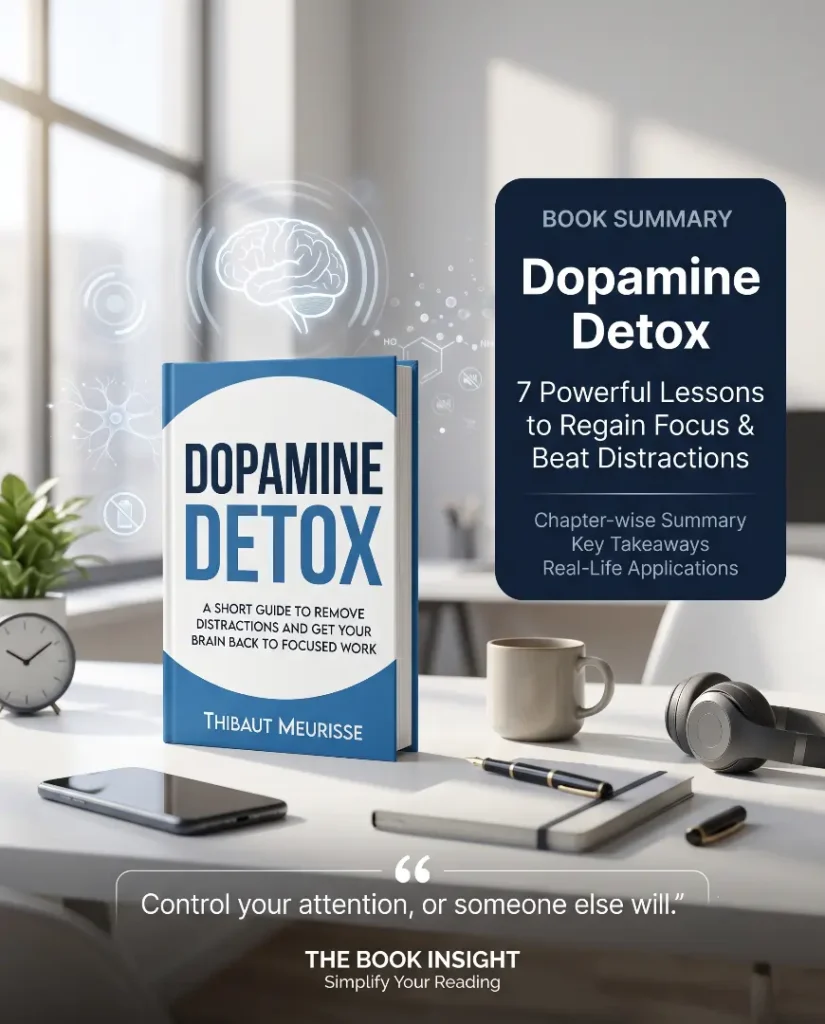
Dopamine Detox Book Summary: The Truth About Your Brain's Hidden Addiction to Distractions
A chapter-wise breakdown of Thibaut Meurisse's Dopamine Detox — why your brain craves distraction, and exactly how to take control back.
Why Your Brain Craves Distractions (and How to Stop It)
In this Dopamine Detox book summary, we'll explore how a tiny brain chemical can control your motivation, habits, and even your happiness. Dopamine — often called the "feel-good" neurotransmitter — drives our urge to seek pleasure, but in today's world, it's being hijacked like never before.
From endless scrolling on social media to binge-watching your favorite shows, modern life is designed to keep you chasing quick dopamine hits. The result? A restless mind, weakened focus, and a constant craving for stimulation. This book reveals why your brain works this way, how these patterns form, and most importantly, how you can reset your brain to take back control.
Before we dive into the key lessons, let's understand what dopamine really is and why it plays such a powerful role in both our survival and our struggles — because once you see the mechanism clearly, the rest of this summary will change how you look at your own phone, your own habits, and your own mornings.
Dopamine isn't the villain — overstimulation is. Your brain releases dopamine in anticipation of a reward, and modern apps, food, and entertainment are engineered to trigger that anticipation constantly, hijacking your attention for profit.
- Chapter 1–2: Dopamine is the "wanting" chemical, and companies exploit it through notifications and infinite scroll.
- Chapter 3: A dopamine detox reduces overstimulation — it doesn't remove dopamine, it resets your sensitivity to it.
- Chapter 4: Success comes from a 3-step system — identify obstacles, add friction, and control your first hour.
- Chapter 5: Focus, consistency, and effect are the three pillars that turn detox into real productivity.
- Chapter 6: Relapse is normal — awareness, a contingency plan, and healthy neurotransmitters keep you on track long-term.
Dopamine Detox — Book Details
Who Should Read This Book?
7 Key Lessons You'll Learn
Understanding Dopamine — The Brain's Reward Messenger
Dopamine is a neurotransmitter — a chemical messenger in the brain — that fuels our desire for rewards. It's the reason we look forward to pleasures like delicious food, physical intimacy, or achieving a goal. Whenever we expect something enjoyable, dopamine is released, creating a sense of anticipation that pushes us to act.
This anticipation is what gives birth to desire. We take action, get the reward, and for a brief moment, feel satisfied. But soon after, there's a sense of emptiness or incompleteness. Our brain craves that same feeling again, pushing us to repeat the activity.
This cycle is harmless in moderation, but in today's world, many activities are engineered to trigger huge dopamine spikes — watching pornography, endlessly scrolling social media, binge-watching shows, or playing video games for hours. These high-intensity dopamine hits keep us hooked, training our brain to seek them again and again. Over time, they form habits, even addictions, that never truly satisfy us.
The problem? These artificially high dopamine triggers hijack our attention and make it harder to focus on tasks that require deep concentration — the very things we plan to do for our growth and success. Most of us have experienced this: we set aside time for something important, but a quick "dopamine fix" steals our attention, leaving us frustrated.
From an evolutionary perspective, dopamine plays an essential role in survival and reproduction. It motivates us to seek food, safety, companionship, and other life-sustaining rewards. But in the modern world, where instant gratification is available at the tap of a finger, dopamine's natural role is often exploited — leading us down a path of distraction, dependency, and decreased self-control.
- Dopamine is the brain's reward chemical, driving us to seek pleasurable experiences.
- Anticipation of a reward often motivates us more than the reward itself.
- Modern technology and entertainment are designed to trigger high dopamine spikes, leading to repeated cravings.
- Overstimulation from constant dopamine hits can make focusing on important tasks more difficult.
- Evolutionarily, dopamine was meant to help us survive and reproduce, but in today's world, it's often hijacked for instant gratification.
The Problem — How Dopamine Hijacks Your Focus
Dopamine is often called the molecule of more because once our brain experiences a pleasurable hit, it naturally wants more of it. The environment we live in today is filled with opportunities for constant dopamine stimulation — and each hit increases the likelihood of us repeating that activity. Whether it's alcohol, gambling, sex, binge-watching TV, playing video games, or even overworking, the pattern is the same: once we start, it's hard to stop.
How Dopamine Has Been Hijacked
In the modern world, focus is the new wealth — and big companies know it. Social media platforms, apps, and entertainment giants spend billions to capture and hold your attention. The longer you stay on their platforms, the more they earn through ads.
Every ping, like, or comment triggers a burst of dopamine, creating hope: Maybe it's a message from someone important... maybe a new like... maybe a new follower. We click to find out — and before we know it, we're trapped in an endless loop.
Algorithms study our habits and feed us exactly what will keep us scrolling — whether it's a product we were already considering or a never-ending stream of videos. While sometimes useful, this constant targeting often leads to endless scrolling, stealing hours from our day and killing our ability to improve focus naturally.
Dopamine and the Trap of Constant Excitement
Scientific studies show that long-term thinking is a powerful predictor of success. Achieving big goals requires vision, patience, and strong mental discipline. Unfortunately, our brains are increasingly wired for short-term rewards.
We already know what's good for us — yet we don't do it:
- We know social media scrolling wastes time, yet we stay glued to it.
- We know junk food harms our health, yet we eat it anyway.
- We know reading and learning can change our life, yet Netflix and web series win our attention.
As our demand for excitement grows, our attention span shrinks. This fuels unhealthy mental models: "Success should come quickly and easily" and "I don't need to work hard to lose weight or earn money." This mindset breeds impatience. When we see others succeed, envy and frustration take over. We start chasing shortcuts, hoping for instant results — and in the process, we break bad habits only to replace them with new ones. The foundation of patience, discipline, and consistency — the real core of success — begins to crumble.
- Dopamine is the molecule of more — once triggered, it pushes us to seek more pleasure.
- Companies design apps and notifications to keep you hooked for profit.
- Constant dopamine hits hijack your brain, making it harder to focus on long-term goals.
- Awareness of bad habits isn't enough — breaking free requires conscious effort to reset your brain.
- Success requires patience and consistency, not the quick-fix mentality fueled by overstimulation.
The Benefits of a Dopamine Detox
What Is Dopamine Detox?
A dopamine detox is a deliberate break from high-stimulation activities that constantly trigger the brain's reward system. The goal is not to remove dopamine entirely — that's impossible and unnecessary — but to reduce overstimulation so your brain can reset to a more balanced state.
When you limit constant pleasure triggers, you regain control over your attention and emotions. This creates mental space to focus on important, meaningful tasks without feeling restless or distracted. In short, it's a way to reset your brain, overcome distractions, and improve focus naturally.
The Three Types of Dopamine Detox
| Type | What It Involves |
|---|---|
| 48-Hour Complete Detox | Removes all artificial dopamine spikes for two full days — no alcohol, internet, phone, games, or junk food. |
| 24-Hour Detox | The same process, limited to one day — ideal for beginners who want to try detoxing without feeling overwhelmed. |
| Partial Detox | A flexible approach — remove only specific high-stimulation triggers while keeping essential daily tools. |
During the 48-hour detox, you replace high-stimulation habits with grounding, low-dopamine activities that help you break bad habits: journaling your thoughts, meditation or deep breathing exercises, reading physical books, taking long walks in nature, and practicing gratitude or reflection.
The partial detox, meanwhile, might mean limiting social media to 10 minutes a day, turning off notifications, replacing junk food with healthy meals, or cutting video games and binge-watching during workdays. It's not about deprivation — it's about regaining control.
It resets your brain to a natural baseline of motivation and pleasure, breaks bad habits by removing the triggers that keep them alive, improves focus naturally by reducing mental noise, encourages long-term thinking, and helps you rediscover joy in simple, everyday activities.
- Dopamine detox is about reducing stimulation, not eliminating dopamine.
- There are three main approaches: 48-hour complete, 24-hour short-term, and partial detox.
- Replacing high-stimulation habits with low-dopamine activities strengthens discipline.
- Even a partial detox can help you overcome distractions and build focus.
- The main benefit is regaining control over your mind, habits, and time.
The 3-Step Approach to a Successful Dopamine Detox
A dopamine detox works best when it's done intentionally and with a clear plan. Many people fail because they try to "just stop" bad habits without building a supportive structure around themselves. This chapter explains a simple three-step formula that helps you successfully reset your brain, break bad habits, and improve focus naturally.
Step 1: Identify Your Biggest Obstacles
Before starting your detox, you must clearly understand what's standing in your way. This begins with honest self-reflection. Take a piece of paper and draw two columns — in the left, list the things you want to do; in the right, list the things you don't want to do.
Ask yourself: Which activities do I keep going back to even though I know they waste my time? What triggers my urge to check my phone or snack mindlessly? What's stopping me from focusing on my goals? You can repeat these questions until you feel clarity, or even talk to a trusted friend or mentor who can help you identify blind spots. This awareness is the foundation for your detox plan.
Step 2: Create Small Barriers (Cause a Little Disturbance)
Human beings are naturally wired for convenience. The easier it is to access something, the more likely we are to overuse it. That's why adding friction between you and your distractions is a powerful tool in a dopamine detox.
- Turn off social media notifications.
- Put your phone in another room or switch it to airplane mode.
- Uninstall apps that you frequently overuse.
- Keep junk food out of your house so you're not tempted late at night.
The more bottlenecks you create, the easier it becomes to overcome distractions and give your brain the space it needs to reset.
Step 3: Control the First Hour of Your Day
What you do in the first hour after waking up sets the tone for the rest of your day. If you start your morning by grabbing your phone and scrolling, you instantly train your brain to seek quick dopamine hits. Instead, begin your day with at least three intentional activities that align with your detox goals — yoga or stretching, gratitude journaling, reading a physical book, playing a musical instrument, or meditation.
By controlling your mornings, you take control of your mindset — a principle also emphasized by Robin Sharma in The 5 AM Club.
Write down what you feel during your detox. If you crave something, note it. If you feel restless, describe the sensation. If you experience clarity, capture the moment. When we put our thoughts on paper, we externalize them — stress and tension lose their grip because the mind no longer needs to hold onto them. Over time, your journal becomes a personal guide to understanding how your mind reacts to detoxing.
- A successful dopamine detox starts with identifying your biggest obstacles.
- Small barriers between you and distractions make it easier to break bad habits.
- Controlling your morning routine is one of the fastest ways to improve focus naturally.
- Journaling your experiences helps you understand your mind and stay committed.
- Consistency in small actions leads to lasting results.
Mastering Productivity & Defeating Procrastination with Dopamine Detox
Why Planning Your Day Is Non-Negotiable
One of the quickest ways to break the cycle of procrastination is to start each day with a clear plan. When you know exactly what needs to be done, you free your mind from decision fatigue and give yourself a structured path to follow. Brian Tracy, in his book Eat That Frog, emphasizes the power of tackling your most important tasks first.
Instead of working reactively, write down 3 to 5 key tasks for the day — arranged by urgency and importance. Once you complete the first task, move on to the second, and keep going until your list is done. These tasks should always be aligned with your long-term life goals, not just busy work that fills your schedule.
The Three Core Pillars of Productivity
While there are countless productivity books and systems, they often come back to these three essential factors:
- Focus — The ability to fully concentrate on one task without falling into distractions from notifications, social media, or unnecessary multitasking.
- Consistency — Progress comes from showing up every day. Even small, regular efforts compound into massive results over weeks, months, and years.
- Effect — Not all tasks are created equal. Prioritize the ones that bring significant long-term results and have a lasting impact on your goals.
Developing Laser-Sharp Focus
A powerful way to train your brain is to work in focused bursts — ideally 45 minutes of deep work — before taking a short break. This technique aligns with the dopamine detox philosophy: removing high-stimulation distractions so your brain can channel its full energy into the task at hand.
If you want to explore more books that approach focus and concentration from different angles, see our Best Books on Focus and Concentration , guide.
5 Steps to Create a Distraction-Free Work Zone:
- Same Place, Same Time — Train your brain by working in the same environment and at the same time each day.
- Choose a Trigger — A simple ritual, like making tea or putting on noise-canceling headphones, signals your brain it's time to work.
- Just Start — Overthinking creates delay. Begin immediately, even if it's for just 5 minutes.
- Avoid Distractions — Keep your phone away, disable notifications, and block distracting websites.
- Work Without Interruptions — Commit to finishing your time block without switching tasks.
When combined with dopamine detox strategies, these habits make it easier to avoid instant gratification traps, beat procrastination, and build unstoppable momentum.
- Detoxing from dopamine-heavy habits requires a gradual, structured approach to avoid burnout or relapse.
- Replacing high-stimulation activities with meaningful, low-dopamine habits strengthens mental clarity and focus.
- Tracking your progress daily builds self-awareness and motivation.
- Reducing digital distractions allows your brain to rewire and adapt to a more balanced reward system.
- Small, consistent steps create long-lasting lifestyle changes.
How to Avoid a Dopamine Relapse and Stay in Control
Breaking free from dopamine-triggering habits isn't a one-time win — it's an ongoing battle. If you're not careful, your brain will pull you back to old patterns. The real challenge isn't starting a dopamine detox, but staying consistent without slipping back into overstimulation.
1. Spot the Warning Signs Early
When you feel yourself sliding into old behaviors, pause immediately. In the early stages of building new habits, your brain will resist change and try to lure you back into instant gratification. This is where self-awareness becomes your greatest tool. Acknowledge the temptation, remind yourself of your goal, and refuse to "just check" that one app — because it's never just once.
2. Master the Battle with Your Thoughts
Relapse often starts in the mind, not in action. Thoughts like "One time won't hurt" or "I deserve a break" trigger cravings. Guilt and self-criticism only make the cycle worse. Instead, treat these thoughts like clouds passing by — notice them, but don't engage. Every time you ignore a craving, you weaken its power over you.
3. Understand the World Is Built to Distract You
Social media, ads, trending videos — they're all designed to hijack your attention because your time and focus are someone else's profit. Every scroll fuels their business model while draining your energy. The best defense is redirecting that time toward meaningful connections — family dinners, real conversations, or shared activities with friends — instead of endless digital noise.
4. Create a Personal Contingency Plan
Have a backup plan for high-risk moments. Imagine this: Nina wakes up at 7 AM, checks her phone "just for messages," then sees a funny Instagram video. One scroll turns into an hour of mindless content, leaving her morning energy completely drained.
To avoid this trap, identify your own danger scenarios: Do you check your phone first thing in the morning? Do you open YouTube "just for 5 minutes" before bed? Prepare replacements — a book by your nightstand, a glass of water on your desk, or a playlist for a short walk — so you can break the autopilot loop.
5. Build a System That Drives You Forward
Willpower alone is fragile. Systems keep you on track when motivation dips. This could be a habit tracker, accountability partner, or even environmental design — like keeping distracting apps off your home screen or using website blockers during work hours.
6. Boost Your Brain with Positive Neurotransmitters
Dopamine isn't the enemy — over-stimulation is. You can still feel pleasure, but from healthy sources that build long-term satisfaction. Activate other "feel-good" neurotransmitters like endorphins (exercise, laughter, or music), oxytocin (genuine social bonding), and serotonin (sunlight exposure, gratitude, and achievement).
Simple practices help: meditation, stretching, mindfulness, contemplative walks, deep social interaction, and — yes — doing nothing. Practicing boredom teaches your brain it doesn't need constant stimulation.
- Relapse is common, but awareness and preparation help you stay on track with your dopamine detox goals.
- Your mind may resist change, but ignoring guilty feelings and cravings prevents slipping into old habits.
- The modern world is designed to capture your attention — consciously choose where you focus.
- A contingency plan helps you handle tempting situations before they derail your progress.
- Boosting natural neurotransmitters like serotonin, oxytocin, and endorphins strengthens emotional well-being.
- Mindfulness, stretching, social connection, and periods of stillness help you live in the present.
How to Apply Dopamine Detox in Real Life
Reading about a dopamine detox is easy. Living it is what actually rewires your brain. Here are 7 practical actions you can start today.
Final Verdict: Is Dopamine Detox Worth Reading?
What makes this book unique is how it refuses to demonize dopamine itself. Instead of another "quit your phone forever" lecture, Meurisse treats overstimulation as the real enemy and gives you a graded system — 48-hour, 24-hour, or partial — to match whatever level of reset you actually need right now.
The 3-step approach (identify obstacles → add friction → control your first hour) is simple enough to start today, without needing a complicated system first.
Because it's a short book, some chapters — especially the productivity section — cover ground that other books (like Deep Work or Atomic Habits) explore in far more depth.
Anyone who feels controlled by their phone, struggles to sit through focused work, or wants a fast, practical starting point rather than a long theoretical read.
Readers who've already read deep neuroscience-focused books on habits and dopamine may find the concepts here familiar rather than new.
Breaking free from constant stimulation isn't about sudden bursts of motivation — it's about creating a system that keeps you consistent every single day. When you plan your day, work with focus, and act on the most important tasks first, you take back control over your time and energy. That control is built step-by-step, not overnight.
By developing laser-sharp focus, reducing distractions, and choosing what truly moves you toward your goals, you don't just get more done — you build a mind that isn't owned by a notification. Every small action you take today compounds into bigger results down the line.
Continue Your Focus & Productivity Journey
If you found this Dopamine Detox summary helpful, you'll love these other powerful reads and guides that will help you level up your productivity, focus, and daily habits:
Frequently Asked Questions
Dopamine Detox is a deliberate break from high-stimulation activities — like social media, junk food, or video games — that constantly trigger the brain's reward system. It doesn't eliminate dopamine; it reduces overstimulation so your brain can reset to a more balanced, focused state.
Yes, when applied consistently. Reducing high-stimulation triggers genuinely lowers mental noise and restlessness, which makes it easier to concentrate on meaningful tasks. It works best as an ongoing practice — not a one-time weekend detox — paired with the 3-step system from Chapter 4.
Thibaut Meurisse wrote Dopamine Detox, part of his self-help series focused on practical, no-fluff strategies for productivity and personal growth.
It depends on your goal. Beginners should start with a 24-hour detox to build confidence without feeling overwhelmed. A 48-hour detox gives a deeper reset, while a partial detox — limiting specific triggers rather than removing everything — is the most sustainable option for everyday life.
A dopamine detox resets your brain's baseline for motivation and pleasure, breaks bad habits by removing their triggers, improves focus naturally, encourages long-term thinking over instant gratification, and helps you rediscover satisfaction in simple, everyday activities.
No — dopamine itself isn't bad. It's a normal, essential brain chemical that motivates us to seek food, safety, connection, and achievement. The problem is overstimulation: modern apps, food, and entertainment are engineered to trigger dopamine constantly, which is what actually damages focus and self-control.
Start by controlling the first hour of your day without screens, add friction between yourself and your biggest distraction (turn off notifications, leave your phone in another room), and work in focused 45-minute blocks in the same place at the same time. Small, repeated actions rebuild your natural attention span far more reliably than willpower alone.